


Evaluating parameterized queries vs. escaping input helps developers choose safer ways to prevent SQL injection. Parameterized queries separate SQL commands from user-supplied values, so input is treated as data rather than executable SQL.
Escaping input attempts to neutralize special characters, but its effectiveness depends on correct handling of character encoding, database syntax, and context. Mistakes in these areas can leave applications vulnerable to injection attacks.
Parameterized queries are generally the preferred approach because they provide a clear separation between query structure and input values. Combined with appropriate database permissions and other security controls, they help reduce SQL injection risks across modern enterprise applications.
Structural Parameter Isolation Eliminates SQL Injection Risk Completely
Separating executable SQL command structures from untrusted variable data isolates database engines from malicious injection attacks.
- Parameter binding guarantees that incoming payload values are parsed exclusively as inert literals rather than executable commands.
- Manual string escaping remains vulnerable to multi-byte character encoding tricks and complex contextual escaping failures.
- Pre-compiled parameterized templates optimize database CPU utilization by eliminating repetitive query parsing cycles.
Why Does Structural Parameterization Outperform String Escaping in Modern Security?
Comparing parameterized queries with escaping input highlights how each method handles untrusted data. String escaping modifies special characters to reduce the risk of injection when input is included in a SQL statement. Its effectiveness depends on the database’s syntax, character encoding, and correct implementation, so mistakes can leave vulnerabilities.
Parameterized queries take a different approach by separating SQL commands from user-supplied values. The database driver binds those values as parameters rather than treating them as part of the SQL command, making this a more reliable defense against SQL injection than manual escaping.
However, this approach depends entirely on developer vigilance and complex, context-aware sanitization logic that can easily fail when encountering unusual character encodings or nested query structures. In contrast, parameterized queries separate the query definition from the parameters entirely, sending the SQL template and user inputs to the database via distinct channels.
By isolating executable command structures from parameter values, database engines pre-compile the SQL template before applying untrusted inputs. This structural separation ensures that even if an input payload contains malicious SQL syntax, the engine evaluates it strictly as a literal data value rather than executable code.
Bypassing manual escaping routines eliminates entire classes of injection vulnerabilities while drastically reducing the complex boilerplate code required to sanitize inputs across multi-tier application architectures.
Ultimately, relying on parameterization rather than manual escaping establishes a robust, deterministic security perimeter that simplifies code maintenance while guaranteeing complete protection against database injection threats.
What Key Technical Differences Define Parameterized Queries Vs Escaping Input?
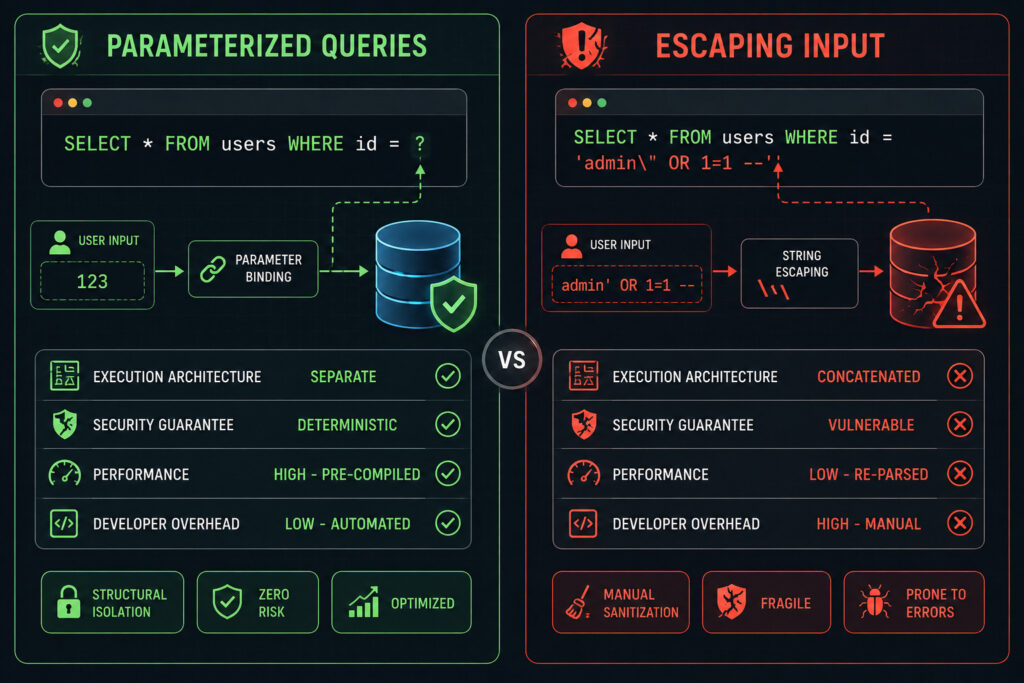
Parameterized queries are generally safer than escaping input because they keep SQL commands separate from user-supplied values. Escaping relies on modifying special characters correctly, which can be error-prone across different database systems and character encodings.
These differences matter when designing secure database access, particularly in applications that handle untrusted input. The security benefits of parameterized queries become clearer when comparing how each method handles input, query execution, and performance.
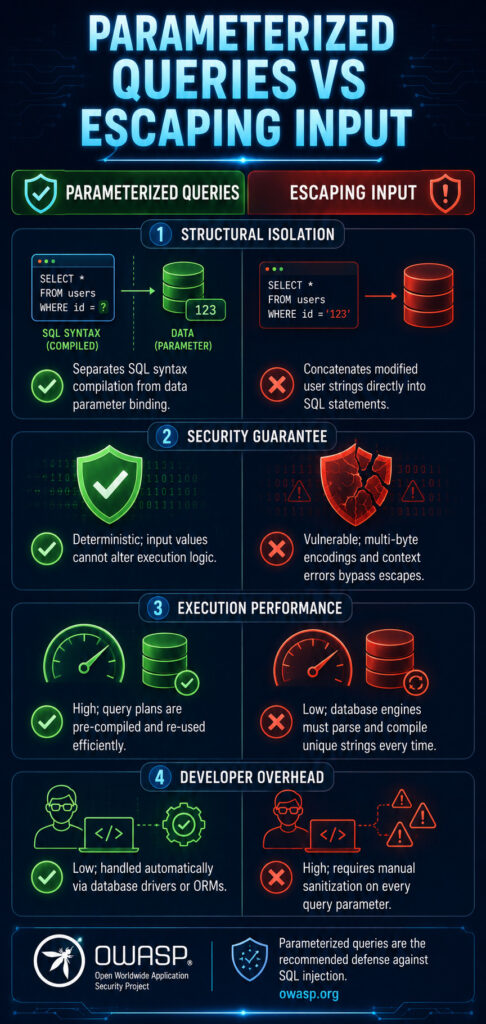
| Architectural Dimension | Parameterized Queries | Escaping Input |
| Execution Architecture | Separates SQL syntax compilation from data parameter binding | Concatenates modified user strings directly into the SQL statement |
| Security Guarantee | Deterministic; input values cannot alter execution logic | Vulnerable; multi-byte encodings and context errors can bypass escapes |
| Execution Performance | High; query plans are pre-compiled and re-used efficiently | Low; database engines must parse and compile unique strings every time |
| Developer Overhead | Low; handled automatically via database drivers or ORMs | High; requires manual sanitization on every query parameter |
Why Do Global Security Standards Discourage Manual Input Escaping?
Security standards favor parameterized queries because they separate SQL commands from user-supplied values, reducing the risk of SQL injection. Manual input escaping relies on correctly handling special characters, database syntax, and character encoding. If implemented incorrectly, it can leave applications vulnerable to malicious input. Parameterized queries provide a more reliable way to preserve query structure and prevent user data from being interpreted as SQL commands.
When developers rely on escaping routines, subtle variations in character encodings or database configurations can bypass sanitization checks completely.
Industry-standard guidance from leading security organizations explicitly defines the inherent vulnerabilities of manual escaping techniques:
“This methodology is fragile compared to other defenses, and we CANNOT guarantee that this option will prevent all SQL injections in all situations.” – OWASP SQL Injection Prevention Cheat Sheet
How Do Parameterized Architectures Block Payload Manipulation Mechanics?
Understanding the differences between parameterized queries and input escaping helps engineering teams choose safer database access patterns. When applications concatenate raw user input into SQL statements, malicious input can alter the intended query structure and introduce unauthorized commands.
Parameterized queries reduce this risk by separating SQL syntax from user-supplied values. The database driver binds inputs to predefined placeholders, preventing those values from being interpreted as SQL commands. This separation is explained in how parameterized queries prevent SQL injection. When implemented correctly, parameter binding provides a reliable defense against injection through parameter values.
Database drivers communicate parameter values using binary transport protocols separate from the initial SQL statement compilation step. The database server compiles the underlying query template into an execution plan before binding untrusted parameters to target placeholders. Consequently, even if a user submits complex SQL syntax or multi-byte escape sequences, the database treats those inputs strictly as literal parameter values rather than executable code.
Adopting automated parameter binding across enterprise applications eliminates whole classes of injection vulnerabilities while streamlining code review workflows.
- Pre-compiled query templates freeze structural command logic before user values are evaluated by the database engine.
- Transporting parameters over isolated channels prevents character encoding bypasses commonly seen in string escaping functions.
- Automated driver parameterization reduces manual developer boilerplate code across modern backend frameworks.
How Do Object-Relational Mappers Enforce Automatic Bind Parameters?
Credits: Codecourse
Modern object-relational mapping (ORM) frameworks simplify database access by handling parameter binding for many common queries. Instead of inserting user input directly into SQL strings, developers can use ORM methods that pass values separately from query instructions.
This distinction matters when comparing parameterized queries with input escaping. ORMs can reduce the risk of SQL injection by generating parameterized statements automatically, but protection depends on how queries are constructed. Raw SQL expressions and dynamically concatenated query strings can still introduce vulnerabilities, so developers should use the framework’s parameter-binding features consistently.
Official documentation for enterprise database abstraction toolkits highlights this automatic parameter binding behavior:
“If we use a literal value (a literal meaning, not a SQLAlchemy clause object), we get a bind parameter.” – SQLAlchemy Core Tutorial Documentation
Can Parameterized Queries Optimize Server Resource Usage?
Parameterized queries can improve database efficiency, particularly when applications execute the same SQL statement repeatedly with different values. By keeping the query structure consistent, they can allow database engines to reuse execution plans, reducing the overhead of repeated parsing and planning.
By contrast, manual string escaping often produces distinct SQL strings when user-supplied values change. Depending on the database engine and its plan cache, this can limit opportunities for plan reuse and increase processing overhead. Parameterization does not guarantee better performance in every situation, but it supports more consistent query execution while reducing SQL injection risks.
Parameterized queries allow database engines to compile the query template once and reuse the cached execution plan across thousands of requests by simply swapping out parameter values.
- Query plan caching reduces database CPU overhead during periods of high application traffic.
- Reusing compiled templates minimizes memory allocation bottlenecks on primary database nodes.
Why Is Parameter Binding Critical Across Diverse Development Frameworks?
Enforcing consistent parameterization standards across varied tech stacks prevents vulnerabilities from entering multi-language backend environments. When enterprise architectures combine different languages like Java microservices and PHP frontends, applying fragmented sanitization rules creates dangerous security blind spots.
Native parameterization helps teams apply consistent SQL injection defenses across different backend environments. Developers can see how this works in prepared statements in Java and PHP, where parameter binding separates SQL commands from user-supplied values.
Compared with manual escaping, parameterized queries reduce reliance on language-specific character handling, which can introduce errors when implemented incorrectly. They also make database code easier to maintain as applications evolve, while helping teams apply consistent security practices across different runtimes.
Parameterized statements bypass character escaping entirely by transmitting command structures and input variables over separate binary communication channels. The database server compiles the SQL logic prior to variable substitution, guaranteeing that untrusted values cannot alter query execution boundaries even when handling complex UTF-8 characters or raw binary streams.
Establishing strict parameter binding guidelines across all development teams ensures long-term application security while simplifying technical compliance audits.
- Standardizing database access via native driver prepared statements provides consistent security across different programming languages.
- Binary parameter transmission eliminates character encoding bypasses commonly associated with string escaping routines.
- Centralized parameterization simplifies automated code analysis and reduces security review overhead for enterprise engineering teams.
FAQ
What is the main difference between parameterized queries vs escaping input?
Parameterized queries separate executable SQL syntax from variable data parameters prior to compilation, whereas escaping input modifies raw user strings by inserting escape characters before concatenating them into a dynamic query string.
Why is escaping input considered fragile for preventing SQL injection?
Escaping input relies on manual character substitution functions that can be bypassed using multi-byte character encoding tricks, database-specific syntax edge cases, or contextual escaping errors introduced by developers.
Do parameterized queries improve database execution performance?
Yes, database engines compile and cache the query execution plan once for a parameterized template, allowing subsequent requests to execute faster by simply binding new parameter values without re-parsing the query syntax.
Can parameterized queries be used with Object-Relational Mapping (ORM) frameworks?
Modern ORM frameworks automatically use parameterized queries under the hood when binding literal values, ensuring that developer code remains secure without requiring manual parameter configuration.
Are parameterized queries sufficient to prevent all web application security threats?
While parameterized queries completely neutralize SQL injection vulnerabilities at the database layer, applications must still implement proper input validation, output encoding, and authorization checks to defend against other web vulnerabilities like XSS and CSRF.
Secure Database Architectures With Structural Parameter Isolation
Understanding the differences between parameterized queries and input escaping helps teams protect enterprise databases against SQL injection. Manual escaping depends on correct character handling and sanitization, which can introduce vulnerabilities when implemented incorrectly.
Parameterized queries separate SQL commands from user-supplied values, reducing the risk of malicious input altering query logic. They can also support more efficient query execution when database engines reuse execution plans, although performance gains depend on the system and workload.
Development teams should make parameter binding a standard practice for database operations, alongside appropriate access controls and other security measures. To strengthen your team’s database security skills, join our secure coding bootcamp and learn how to apply these practices in production environments.
References
- https://cheatsheetseries.owasp.org/cheatsheets/SQL_Injection_Prevention_Cheat_Sheet.html#defense-option-4-strongly-discouraged-escaping-all-user-supplied-input
- https://docs.sqlalchemy.org/en/14/core/tutorial.html