


Parameterized queries in stored procedures help keep databases secure and improve performance. They separate SQL commands from user input, reducing the risk of SQL injection attacks. They can also help databases reuse query plans, which may speed up repeated operations.
For developers, this means better protection for sensitive data and more efficient database processing. Using parameterized queries is a key part of secure coding practices, especially in systems that handle many requests at once.
Keep reading to learn how parameterized queries work and how they help protect your database.
Encapsulated Database Execution Improves Security and Performance
Stored procedures keep SQL commands in the database, while parameterized queries separate those commands from user input. This approach helps protect data and improves database management.
- SQL injection protection: Separating SQL code from user input reduces the risk of malicious commands.
- Lower processing overhead: Reusing query execution plans can reduce the work needed to process repeated queries.
- Centralized security controls: Managing database logic in stored procedures helps teams apply access rules consistently across applications.
These practices help developers build secure and efficient database systems.
How Do Stored Procedures Parameterized Queries Benefits Enhance Enterprise Database Defense?
Stored procedures with parameterized queries help protect databases by keeping SQL commands separate from user input. The database treats incoming parameters as data, not executable code, reducing the risk of SQL injection attacks.
This approach can also improve performance. Database systems may reuse query execution plans instead of repeatedly processing the same SQL structure, reducing CPU usage during busy periods.
Stored procedures also make access control easier to manage. Database administrators can grant applications permission to run specific procedures without giving them direct access to underlying tables. This helps limit access to sensitive data and supports the principle of least privilege.
What Distinguishes Parameterized Stored Procedures From Dynamic SQL Execution?
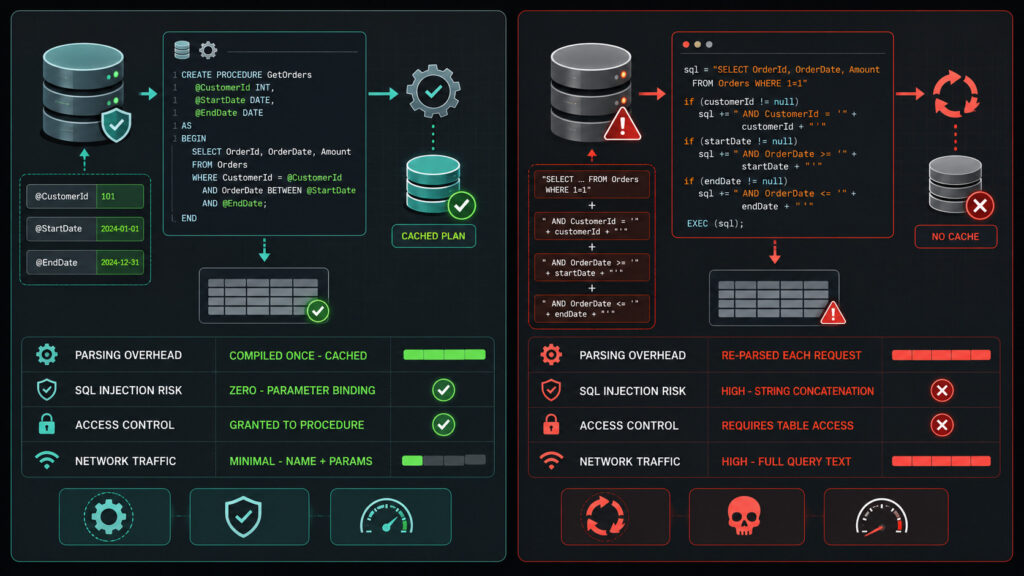
Parameterized queries in stored procedures can improve database security and performance compared with building SQL commands from raw text in application code. Stored procedures may allow database systems to reuse execution plans, reducing the work needed to process repeated queries.
Parameter binding also keeps user input separate from SQL commands, reducing the risk of SQL injection. Using parameterized queries for database security helps developers apply this approach across applications while protecting sensitive data.
The table below illustrates the operational differences between parameterized stored procedures and dynamic SQL execution:
| Evaluation Criteria | Parameterized Stored Procedures | Dynamic SQL Execution |
| Parsing Overhead | Compiles statement structure once; reuses execution plans | Parses and compiles execution tree on every incoming request |
| SQL Injection Risk | Eliminates injection vectors via strict parameter placeholder binding | High risk if user inputs are concatenated directly into SQL text |
| Access Control | Restricts permissions directly to procedure execution endpoints | Requires direct table read or write access permissions for applications |
| Network Traffic | Transmits minimal procedure names and variable data arguments | Sends full raw SQL query strings across application network links |
How Do Database Management Systems Improve Stored Procedure Security?
Stored procedures improve database security by keeping SQL commands separate from user input. They also help control access to sensitive data and reduce repeated query processing. Instead of allowing applications to access database tables directly, developers can use stored procedures to provide controlled access to specific operations.
When an application calls a parameterized stored procedure, the database receives input values separately from the SQL commands. This separation helps stop malicious input from changing the query’s structure or adding unauthorized commands. As a result, stored procedures can reduce the risk of SQL injection attacks, especially when developers avoid unsafe dynamic SQL and set proper access permissions.
Industry-leading database documentation explicitly highlights the core architectural advantages of leveraging server-side stored procedures:
“Benefits of using stored procedures: Reduced server/client network traffic; Stronger security; Reuse of code; Easier maintenance; Improved performance.” – Microsoft SQL Server Stored Procedures Documentation
How Do Parameterized Stored Procedures Prevent Execution Tree Manipulation?
Credits: Database Star
Stored Procedures Parameterized Queries Benefits are rooted in the fundamental isolation of executable query structures from untrusted data inputs. When an application passes variable values into a parameterized procedure, the database engine processes the structural command tree independently.
Driver-level parameter binding separates SQL commands from user-supplied values, helping prevent malicious input from changing query structure. In how parameterized queries prevent SQL injection, this separation is central to understanding how databases handle queries safely. Depending on the database and driver, statements may be prepared before execution, with parameter values supplied separately at runtime.
Incoming parameters cannot modify the query logic, inject new relational operators, or append unauthorized control commands. This rigid structural barrier ensures that even crafted attack payloads fail to alter the intended database behavior.
Additionally, this pre-compiled architecture allows database query planners to reuse cached execution paths across millions of incoming API requests. Rather than re-parsing identical statement structures repeatedly, the database engine simply swaps out parameter values in memory, preserving critical CPU resources.
- Pre-compiled statement graphs prevent untrusted inputs from altering the query execution structure.
- Parameter arguments pass through dedicated memory channels strictly as literal, non-executable data.
- Shared execution plan caching drastically cuts database CPU utilization during high-concurrency traffic spikes.
How Do Stored Procedures Enforce Least Privilege Security Models?
Stored Procedures Parameterized Queries Benefits include the ability to enforce strict access control boundaries without granting applications full table permissions. By routing all database interactions through parameterized stored procedures, database administrators can restrict user accounts from executing direct SELECT, INSERT, or DELETE statements on core schema tables.
This abstraction layer ensures that even if an application credential is compromised, attackers cannot run arbitrary queries against underlying tables. The stored procedure acts as a secure boundary, executing queries with predefined parameters and restricting unauthorized data extraction.
Enterprise security documentation highlights how stored procedures decouple user permissions from database schemas:
“Unlike command text, parameter input is treated as a literal value, not as executable code. This helps guard against ‘SQL injection’ attacks.” – Microsoft, ADO.NET Configuring Parameters
Are Parameterized Stored Procedures Always Secure?
Stored Procedures Parameterized Queries Benefits apply only when internal procedure statements avoid dynamic SQL construction. If a stored procedure builds queries internally using dynamic string concatenation with unvalidated parameters, it remains vulnerable to SQL injection regardless of external parameter binding.
- Dynamic SQL concatenation inside procedure definitions bypasses structural parameter isolation completely.
- Parameterized execution guarantees protection only when variable inputs are bound directly to static statement handles.
How Do Modern Runtimes Integrate Parameterized Stored Procedures?
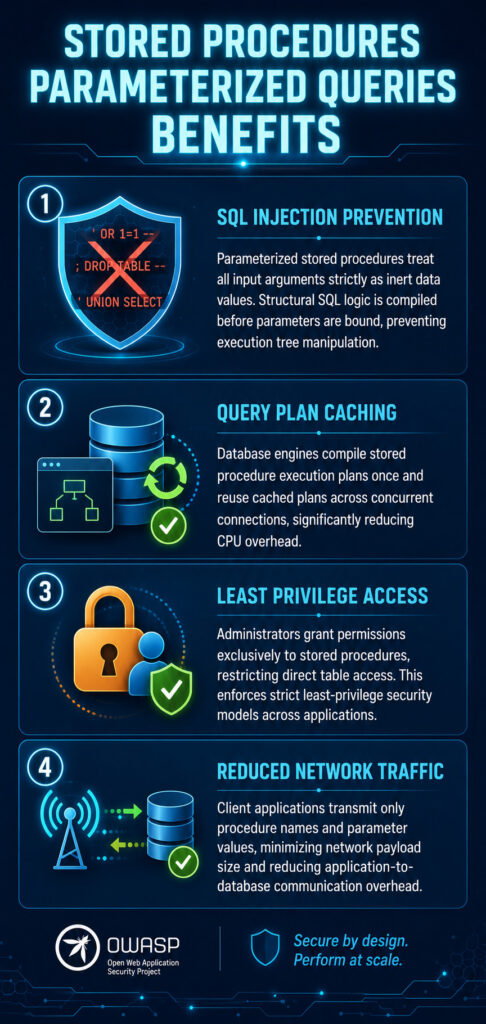
Stored procedures and parameterized queries help applications written in Java, PHP, C#, and Python communicate securely with databases. They separate user input from SQL commands, reducing the risk of SQL injection across different programming environments.
Database drivers connect backend applications to database systems and pass input values to stored procedures. This helps keep user data separate from SQL commands as information travels across the network. Developers can apply similar techniques when using prepared statements java php to handle database queries safely in their applications.
Built-in database drivers and parameter binding also reduce the need to format SQL queries manually. Many frameworks handle parameter binding automatically, helping applications send values with the correct data types. This reduces common coding mistakes and makes database operations easier to manage.
Using consistent methods to call stored procedures can simplify maintenance and improve security across multiple services. Development teams can review database access more easily and apply the same security rules across different applications.
Key benefits include:
- Safer data handling: Database drivers keep input values separate from SQL commands.
- Better input control: Parameter binding helps the database process values according to their expected data types.
- Easier maintenance: Consistent methods for calling stored procedures make code easier to review and update across development teams.
FAQ
What is the main operational benefit of using stored procedures and parameterized queries?
The primary operational advantage is the strict structural separation between executable SQL logic and variable data inputs. By compiling query templates beforehand, database engines treat incoming arguments strictly as inert literal values, neutralizing SQL injection threats while eliminating repetitive statement parsing overhead.
Can a stored procedure still be vulnerable to SQL injection?
Yes, a stored procedure can remain vulnerable if developers use dynamic string concatenation inside the procedure body instead of native parameter binding. To maintain security, internal statements must bind variables directly to static parameter handles rather than assembling dynamic SQL text at runtime.
How do parameterized stored procedures improve database query performance?
Parameterized stored procedures allow database management systems to compile and cache execution plans upon initial invocation. Subsequent requests with varying parameters reuse the cached plan directly, significantly reducing server CPU overhead, minimizing memory fragmentation, and accelerating throughput during traffic spikes.
How do stored procedures support the principle of least privilege?
Stored procedures allow database administrators to grant permissions exclusively to specific execution routines while revoking direct access to underlying schema tables. Client applications can execute authorized transactions through predefined procedure boundaries without possessing direct table modification rights.
Do all major database management systems support parameterized stored procedures?
Yes, major database management systems including SQL Server, PostgreSQL, MySQL, and Oracle fully support parameterized stored procedures. Native database drivers handle argument binding at the binary protocol level to ensure secure transmission between backend application servers and database nodes.
Improving Enterprise Database Security with Parameterized Stored Procedures
Stored procedures and parameterized queries help protect databases by separating SQL commands from user input. Stored procedures group database operations into reusable routines, while parameterized queries keep input values separate from SQL instructions. Together, they reduce the risk of SQL injection when implemented correctly.
Stored procedures can also improve performance by allowing database systems to reuse execution plans. Access permissions let developers limit which operations an application or user can perform, following the principle of least privilege. These measures help protect sensitive data while keeping database operations efficient.
Development teams can strengthen their database security skills and apply safer coding practices by joining our secure coding bootcamp.
References
- https://learn.microsoft.com/en-us/sql/relational-databases/stored-procedures/stored-procedures-database-engine?view=sql-server-ver17
- https://learn.microsoft.com/en-us/dotnet/framework/data/adonet/configuring-parameters-and-parameter-data-types