


Parameterized queries cannot handle every dynamic SQL requirement, particularly when applications need to change table names, column names, or sorting rules at runtime. Understanding these limitations helps developers choose the right safeguards without relying on unsafe string concatenation.
Secure Coding Practices examines where parameter binding falls short and how to handle these cases securely while keeping application performance in mind. Keep reading to learn how to address these challenges in enterprise applications.
Understanding Architectural Constraints Ensures Secure Backend Execution
Recognizing the strict execution boundaries of prepared statements allows development teams to build resilient database interfaces.
- Limitations Parameterized Queries Scenarios primarily emerge when attempting to parameterize table names, column identifiers, or schema definitions.
- Database engines strictly prohibit parameter markers for SQL keywords, limiting their use exclusively to scalar data values.
- Dynamic sorting parameters or Data Definition Language (DDL) operations require strict server-side allow-listing architectures instead of native parameter binding.
How Do Structural Rules Affect Database Interfaces?
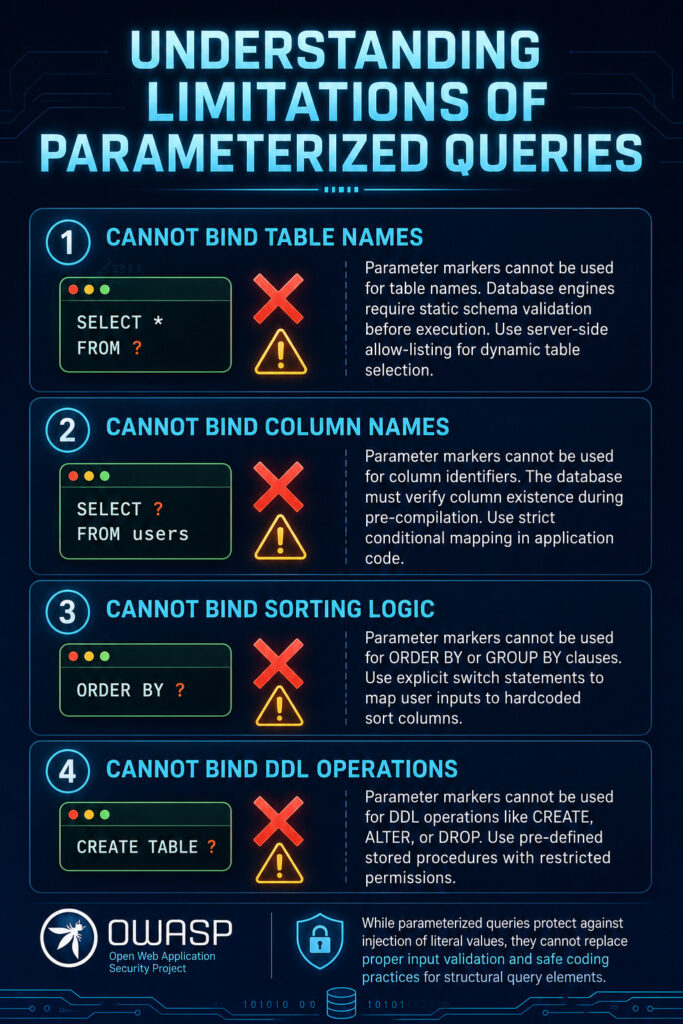
Parameterized queries separate SQL commands from input values, but the query structure generally needs to be defined before those values are supplied. This means developers cannot usually use parameters to replace structural elements such as table names, column identifiers, or sorting directions.
For example, attempting to bind a table name in a FROM clause or a column name in an ORDER BY clause typically won’t work as expected. To handle these requirements safely, developers should map user input to predefined, trusted identifiers and use parameterized queries for data values. This approach preserves flexibility while helping prevent SQL injection.
Backend applications needing dynamic column selection must map user inputs to hardcoded architectural logic prior to execution. Attempting to bypass these structural rules causes immediate parser failures and query rejections across database management systems.
Engineering teams must anticipate these constraints during the initial system architecture phase. Designing data access layers around static structural trees prevents technical debt and ensures long-term database stability.
What Are The Primary Differences Between Static and Dynamic Requirements?
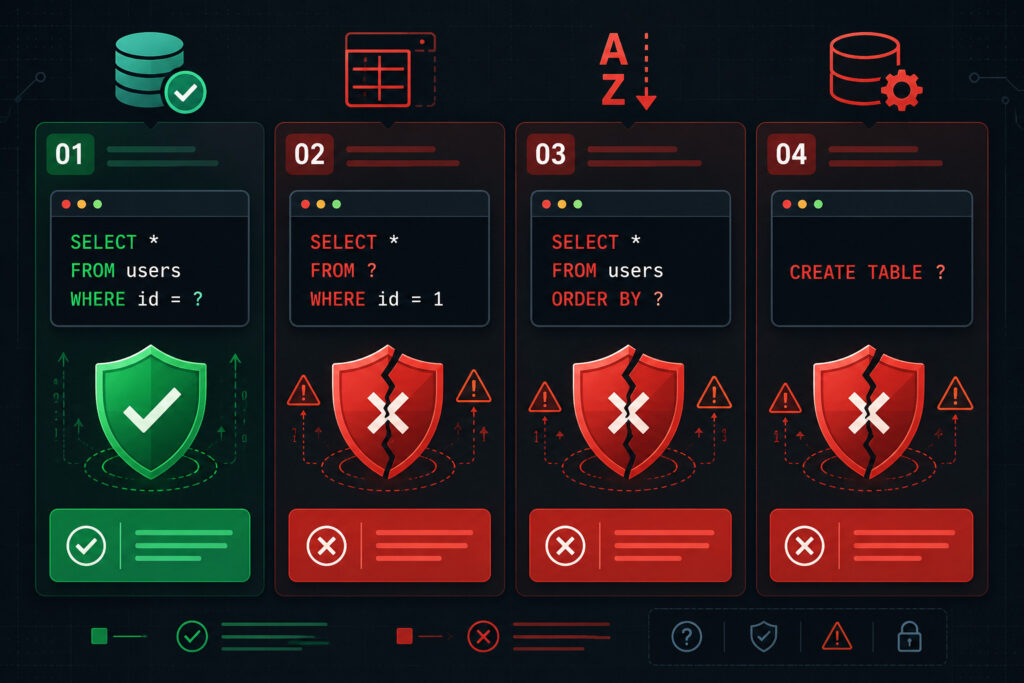
The limitations of parameterized queries become clearer when comparing routine database operations with dynamic administrative tasks. Standard operations, such as retrieving or inserting records, work well with prepared statements because the query structure stays consistent while the data values change.
More complex analytical queries may require dynamic column selection, sorting, or grouping. Since parameters generally cannot replace SQL identifiers or keywords, developers should map these structural elements to predefined, trusted options while continuing to parameterize data values. This approach supports dynamic query requirements without exposing the application to unnecessary SQL injection risks.
Developers can address native execution restrictions by using alternative architectural safeguards that validate query structures and control how applications interact with databases. These approaches complement parameterized queries for database security, particularly when standard parameter binding is not feasible.
The table below outlines the core differences between natively supported parameter scenarios and restricted dynamic requirements:
| Query Component | Parameterization Support | Secure Implementation Strategy |
|---|---|---|
| Literal Data Values (WHERE, INSERT) | Fully Supported | Native driver parameter binding |
| Column/Table Identifiers (SELECT, FROM) | Not Supported | Server-side allow-listing and input mapping |
| Sorting Logic (ORDER BY ASC/DESC) | Not Supported | Strict conditional mapping in application code |
| Database Schema Modifications (DDL) | Not Supported | Pre-defined administrative stored procedures |
Why Do Database Engines Restrict Parameter Markers?
Database engines need to identify tables, columns, and SQL operations when parsing a query and planning its execution. Parameter markers are designed to represent data values, not structural elements such as table names or SQL keywords.
These restrictions help the database determine how to execute a statement before the parameter values are supplied. When an application needs dynamic table or column selection, developers should map user input to predefined, trusted identifiers and continue using parameters for data values.
If an identifier is parameterized, the database engine cannot determine the appropriate internal index or execution strategy. This rigid architectural requirement ensures execution stability but restricts developer flexibility when constructing dynamic queries.
Official database documentation strictly defines these operational boundaries for backend engineers:
“Parameter markers can be used only where data values should appear, not for SQL keywords, identifiers, and so forth.” – MySQL PREPARE Statement Documentation
How Should Developers Handle Dynamic Identifiers?
When applications need dynamic column names or sorting options, developers must use safeguards beyond parameter binding. Since query parameters generally cannot represent SQL identifiers, server-side validation is essential to reduce SQL injection risks.
A reliable approach is to compare incoming values against an allowlist of approved column names and sorting options, then map valid inputs to trusted identifiers in the query. Parameterized queries should still be used for data values, keeping user input separate from SQL commands.
Structural execution constraints can limit how applications handle dynamic SQL statements, especially in complex enterprise architectures. Understanding how parameterized queries prevent SQL injection helps developers identify where alternative safeguards may be necessary to protect database operations.
The most secure approach for dynamic table selection involves implementing rigorous allow-lists within the application logic. By mapping incoming API requests to pre-verified, static string identifiers, the application ensures that only trusted schema components reach the database engine.
- Map dynamic user input directly to hardcoded server-side variables before query execution.
- Reject any incoming API request containing column or table parameters that fall outside the approved allow-list.
- Avoid relying on basic input sanitization routines when handling structural query identifiers.
How Do Restrictions Impact Data Definition Language?
Credits: Bert Wagner
Parameterized queries have limitations when it comes to administrative tasks involving Data Definition Language (DDL), which includes operations such as creating, altering, or dropping database objects. Prepared statements are primarily designed to handle data values in Data Manipulation Language (DML) operations, such as selecting, inserting, or updating records.
Because parameters generally cannot replace structural elements like table names or column identifiers, developers must use other safeguards when building dynamic DDL statements. Allow-listing approved identifiers and restricting database permissions can help reduce SQL injection risks during administrative operations.
Database engines universally block attempts to parameterize structural commands like CREATE TABLE or DROP INDEX. Administrative automation scripts must therefore utilize highly restricted permissions and isolated execution environments when executing dynamic DDL tasks.
The core limitations surrounding dynamic execution are thoroughly documented by leading database vendors:
“Dynamic parameters can only be used in DML statements.” – MySQL Prepared Statements Parameter Restrictions
Can ORM Frameworks Bypass Execution Limits?
ORM frameworks cannot bypass the underlying restrictions of parameterized queries. Although they simplify database interactions and reduce the need to write raw SQL, they still rely on database drivers to execute queries.
Most ORMs support parameterized queries for data values, but they generally cannot bind structural elements such as table names or column identifiers. Developers must handle dynamic query structures with allowlists and trusted identifiers, even when working through an ORM.
- ORMs generate static query structures dynamically based on application logic, not through raw identifier parameterization.
- Attempting to inject dynamic column names through ORM native-query bypasses triggers immediate driver validation errors.
- Developers must utilize native ORM dynamic querying APIs rather than forcing raw string interpolation for advanced filtering.
What Strategies Mitigate Complex Sorting Logic?
Parameterized queries can pose challenges for API endpoints that support dynamic sorting or pagination. Since an ORDER BY clause requires column identifiers, applications generally cannot pass user-defined column names directly as query parameters.
Backend microservices can handle dynamic sorting securely by validating incoming parameters and mapping them to approved column names through conditional switch statements. For applications built in Java or PHP, prepared statements help separate SQL commands from user-supplied values, while explicit validation protects query components that cannot be parameterized, such as column names and sort directions.
The application explicitly defines the sorting clause using verified string literals before sending the finalized query structure to the database execution engine. This translation layer guarantees that malicious actors cannot inject unauthorized schema operators into the sorting sequence.
- Utilize explicit switch statements in application code to handle dynamic sort directions securely.
- Fallback to a hardcoded default sorting column if the user provides unrecognized input parameters.
- Ensure API documentation explicitly states which data columns support dynamic sorting capabilities natively.
FAQ
What are the main Limitations Parameterized Queries Scenarios?
The primary limitations involve the inability to use parameter markers for structural database identifiers, including table names, column names, SQL operators, and sorting directions. Database engines require a static execution structure to compile the query plan securely.
Why can I not parameterize table names in queries?
Database engines compile execution plans by verifying schema structures, data types, and index availability before execution. If a table name is parameterized, the database cannot validate the query structure or calculate an optimized execution path, resulting in an immediate parser error.
How do developers handle dynamic column selection securely?
Developers must use strict server-side allow-listing to map incoming user input to hardcoded column identifiers. This logic guarantees that only pre-approved, safe string literals are inserted into the structural query tree before execution begins.
Do parameter restrictions apply to DDL operations?
Yes, parameter binding is strictly limited to Data Manipulation Language (DML) operations like SELECT, INSERT, and UPDATE. Data Definition Language (DDL) commands, such as creating or altering tables, cannot utilize dynamic parameter markers natively.
Will upgrading my database driver bypass parameter limits?
No, parameter restrictions are enforced by the core relational database management system engine, not the driver API. The requirement for deterministic pre-compiled execution plans applies universally across modern enterprise database systems and driver iterations.
Mastering Database Security and Architectural Boundaries
Understanding the limitations of parameterized queries helps teams design more secure database architectures. Prepared statements help prevent SQL injection by separating data values from SQL commands, but they generally cannot parameterize structural elements such as table names, column identifiers, or sorting directions.
To handle dynamic query requirements safely, developers should validate identifiers against server-side allowlists, map accepted inputs to trusted values, and use database views where appropriate to control data access. Avoiding unsafe string concatenation and applying these practices consistently helps protect production microservices from SQL injection risks.
For practical guidance on secure coding and backend threat mitigation, join our secure coding bootcamp.
References
- https://dev.mysql.com/doc/refman/9.0/en/prepare.html
- https://dev.mysql.com/doc/refman/9.0/en/sql-prepared-statements.html