


Software developers need secure coding practices training to identify vulnerabilities, reduce security risks, and prevent flaws before applications reach production. The OWASP Top 10 offers a practical reference for understanding common application security risks, such as injection attacks and broken access control.
Through hands-on training, developers can learn to apply security controls at each stage of the software development lifecycle (SDLC). These skills help engineering teams address potential weaknesses earlier and build security into their daily development work.
Keep reading to explore the practices, skills, and training approaches that support more secure software development.
Secure Coding Quick Wins
A strong secure coding program helps developers build safer applications by combining practical skills, consistent security practices, and ongoing learning.
- Secure coding training teaches developers to prevent common vulnerabilities through safer programming techniques, security standards, and practical exercises.
- Effective programs combine hands-on labs, role-specific instruction, and automated security testing to address application risks early.
- Continuous training and measurable security outcomes help organizations maintain safer development practices as applications evolve.
Why Do Developers Need Secure Coding Practices Training?
Developers need secure coding practices training because small programming mistakes can expose applications, databases, and sensitive user information. Security knowledge helps engineers recognize unsafe coding patterns before those weaknesses reach production.
The OWASP Top 10 identifies common web application security risks, including injection, security misconfiguration, cryptographic failures, and broken access control. These vulnerabilities can occur when developers overlook input validation, authorization checks, or secure configuration.
Finding security flaws after deployment can also increase operational costs. Teams may need to issue emergency patches, investigate incidents, repeat security tests, and notify affected customers. Addressing weaknesses earlier gives developers more control over the remediation process.
Our approach to Secure Coding Practices connects security knowledge with everyday programming responsibilities. Developers build the skills to recognize and prevent security weaknesses and learn how implementation decisions affect the confidentiality, integrity, and availability of an application throughout its lifecycle.
What Secure Coding Practices Should Every Developer Learn?

Every developer should understand input validation, output encoding, authentication, authorization, encryption, and secure error handling. These practices address common weaknesses in web applications, APIs, databases, and other software components.
The OWASP Secure Coding Practices Quick Reference Guide offers practical recommendations for implementing these controls. Developers can use it alongside language-specific security standards and internal engineering policies.
Although the exact requirements depend on the programming language and application architecture, several practices apply across most development environments.
How Can Developers Prevent SQL Injection and XSS?
Developers can reduce SQL injection risks by separating database commands from user input. They can also reduce XSS risks through context-aware output encoding.
Input validation should take place on the server, even when an application already checks information in the browser. Client-side checks improve usability, but attackers can bypass them and send requests directly to an endpoint.
Useful techniques include:
- Allowlist validation: Accept only expected data types, lengths, formats, and character sets.
- Parameterized queries: Use prepared statements instead of inserting user input directly into SQL commands.
- Output encoding: Encode untrusted data according to its destination, such as HTML, JavaScript, CSS, or URL contexts.
- Content Security Policy (CSP): Apply browser security rules that restrict which scripts and other resources a page can load.
What Does a Secure Coding Training Program Include?
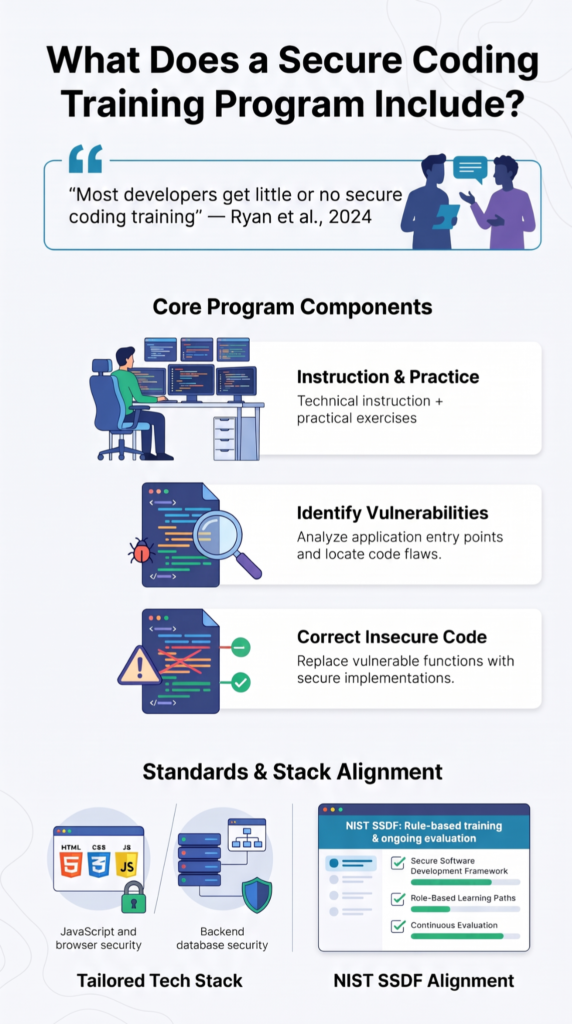
An effective secure coding training program combines technical instruction, practical exercises, and security-focused development activities. Developers need opportunities to identify vulnerabilities, understand their causes, and correct insecure code.
“We find that while some developers experience excellent secure-coding training, others receive inadequate training, and the majority receive none.” – Ryan, Roedig, and Stol, ACM/IEEE (2024)
The NIST Secure Software Development Framework (SSDF) recommends role-based training and ongoing evaluation for personnel involved in software development. This helps organizations connect security education with actual engineering responsibilities.
Training should also reflect the technologies developers use. A JavaScript developer, for example, may need more instruction on browser security, while a backend engineer may require deeper knowledge of database queries and API authorization.
Do Hands-On Secure Coding Labs Work Better Than Theory Alone?
Hands-on secure coding labs help developers apply security concepts to realistic programming scenarios. They can identify weaknesses, test potential attacks, and correct vulnerable code in controlled environments.
A presentation can explain how SQL injection works, but a practical exercise shows developers how unsafe query construction creates the vulnerability. They can then replace the original implementation with parameterized queries and test the result.
Common training activities include:
- Vulnerability identification: Examine intentionally insecure applications and locate weaknesses.
- Exploit-and-fix exercises: Reproduce attacks in controlled environments before implementing secure alternatives.
- Secure code review: Examine applications for unsafe functions, missing authorization checks, and exposed secrets.
- Threat modeling: Identify potential attackers, application entry points, sensitive assets, and appropriate security controls.
OWASP Juice Shop and OWASP WebGoat provide intentionally vulnerable environments for application security education. Developers can practice identifying weaknesses without testing against production systems.
Training should also cover remediation and verification. Finding a vulnerability is only part of the exercise. Developers need to understand why the original code failed and how the corrected implementation addresses the problem.
Should Secure Coding Training Be Different for Each Developer Role?
Yes. Secure coding training should reflect each developer’s responsibilities, programming environment, and access to application components. Role-specific instruction helps teams focus on security risks relevant to their daily work.
The NIST SSDF supports training based on personnel roles rather than providing identical instruction to every employee.
Different engineering teams face different security challenges:
- Frontend developers need to understand browser security risks, including DOM-based XSS, Cross-Origin Resource Sharing (CORS), Content Security Policy, and unsafe client-side storage.
- Backend developers need deeper instruction in SQL injection prevention, Server-Side Request Forgery (SSRF), insecure deserialization, API authentication, and authorization.
- DevOps and Site Reliability Engineering (SRE) teams require training in Infrastructure as Code (IaC) security, container image scanning, CI/CD pipeline protection, and Identity and Access Management (IAM).
This approach makes training more relevant to each team. It also helps developers recognize security issues that might fall outside their immediate responsibilities.
How Does Secure Coding Fit Into the Software Development Lifecycle?
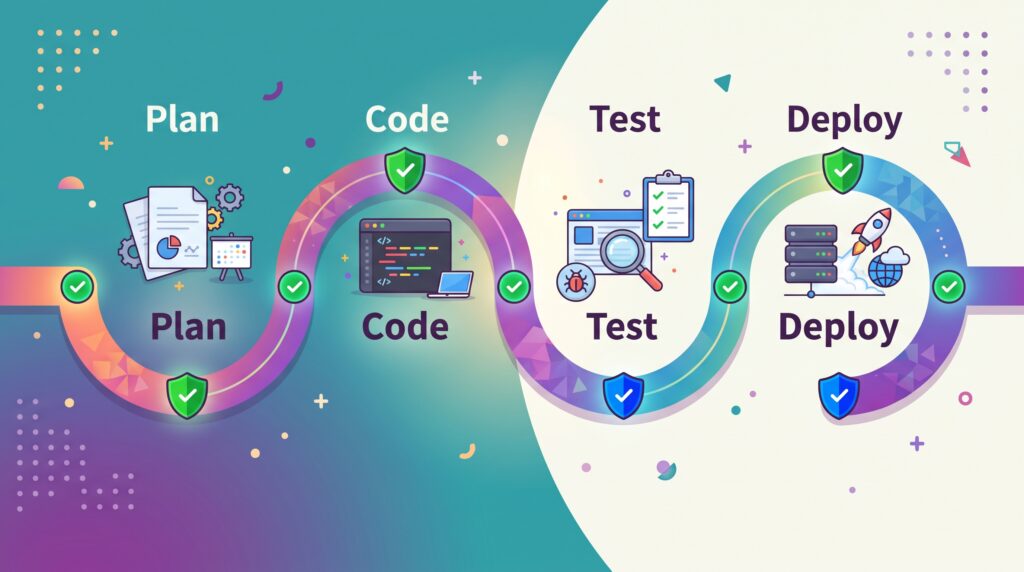
Secure coding should be part of every stage of the software development lifecycle (SDLC), from initial planning to production maintenance. This gives developers opportunities to identify weaknesses before they become harder to address.
“Following these practices should help software producers reduce the number of vulnerabilities in released software.” – NIST
The Secure SDLC incorporates security requirements, threat modeling, secure design, code reviews, and security testing into normal development activities. DevSecOps extends this approach by integrating security checks into automated development and deployment workflows.
For example, developers can receive warnings from IDE plugins when they introduce potentially unsafe functions. Automated pipeline checks can then identify vulnerable dependencies or exposed credentials before code reaches production.
The NIST SSDF describes practices that organizations can incorporate into existing software development processes rather than treating security as a separate activity.
How Can Organizations Measure Secure Coding Training Results?

Organizations can measure secure coding training results by examining changes in developer behavior and application vulnerability trends. Course completion alone does not show whether employees can apply security controls correctly.
Building secure development practices across the software lifecycle also requires teams to evaluate whether developers consistently apply security controls in their work.
The NIST SSDF recommends reviewing personnel proficiency and training effectiveness over time. Organizations should combine learning assessments with operational security metrics.
For example, a team might report high course completion rates but continue introducing the same authorization defects in new releases. This may indicate that training content, practical exercises, or development controls need improvement.
Which Metrics Show Whether Developer Security Training Works?
Several metrics help organizations assess whether developer training improves software security. Useful measurements connect learning activities with changes in vulnerability detection, remediation, and recurrence.
Organizations can track:
- Training completion rate: Measures the percentage of developers who complete required secure coding modules.
- Hands-on lab pass rate: Evaluates whether developers can identify and correct vulnerabilities in practical exercises.
- Vulnerability density: Tracks security defects relative to a consistent measure of code size, components, or releases.
- Mean Time to Remediate (MTTR): Measures the average time needed to resolve identified security vulnerabilities.
- Repeat defect rate: Tracks how often previously addressed weaknesses, such as SQL injection or XSS, reappear in later releases.
These measurements need consistent definitions. For example, vulnerability density should use the same measurement method across releases to support meaningful comparisons.
Organizations should also examine vulnerability severity. A reduction in low-risk findings does not necessarily indicate better security if critical authentication or authorization weaknesses remain unresolved.
Production incidents, penetration-test results, internal code reviews, and vulnerability reports can provide further feedback. Teams can use these findings to update training materials and address knowledge gaps.
What Should You Look for in Secure Coding Practices Training?
Source: Simplilearn
Effective secure coding education programs should teach developers how to prevent real application vulnerabilities through practical exercises, recognized security frameworks, and role-specific instruction. Organizations should evaluate a program’s technical depth and ongoing relevance before adopting it.
A useful training program should cover:
- Recognized security frameworks: OWASP guidance, the OWASP Top 10, and relevant NIST recommendations.
- Practical vulnerability exercises: Opportunities to identify and remediate insecure code in controlled environments.
- Relevant technical coverage: Input validation, SQL injection prevention, XSS mitigation, authentication, authorization, encryption, and API security.
- Role-based learning: Separate learning paths for frontend, backend, mobile, and DevOps professionals.
- Development workflow integration: Guidance on SAST, DAST, dependency scanning, secure code reviews, and DevSecOps.
- Measurable learning outcomes: Assessments that show whether developers can apply secure coding techniques.
Organizations should also check whether training materials are updated as programming languages, application architectures, and attack methods change. A course that only covers familiar vulnerabilities may leave developers unprepared for security weaknesses introduced by newer technologies.
Our Secure Coding Practices approach puts practical security education first, connecting developer knowledge with established coding standards and the software development lifecycle. This helps organizations make security a consistent part of engineering decisions without separating it from everyday development work.
Secure coding remains an ongoing responsibility. Continuous education, effective security testing, and regular code reviews help teams reduce preventable vulnerabilities and protect their applications.
For organizations looking to strengthen their development security capabilities, Contact Secure Coding Practices to discuss training approaches that support a more consistent and security-focused engineering process.
FAQs
How Can Developers Apply Secure Coding Guidelines Without Slowing Down Development?
Developers can follow secure coding guidelines by using reusable code patterns, automated security checks, and consistent coding standards. Secure coding training helps developers identify vulnerabilities early while maintaining an efficient workflow. Integrating security checks into everyday development tasks also makes secure software development easier to manage as projects become more complex.
Which Security Vulnerabilities Should Developers Learn to Prevent First?
Developers should prioritize common vulnerabilities such as SQL injection, cross-site scripting (XSS), cross-site request forgery (CSRF), and broken access control. Training should cover input validation, output encoding, parameterized queries, and authorization checks. These techniques help developers prevent common attacks and reduce the risk of exposing sensitive application data.
How Can Teams Measure Whether Secure Coding Training Improves Code Quality?
Teams can measure the effectiveness of secure coding training by tracking code review findings, security testing results, vulnerability reports, and remediation times. Static application security testing (SAST) and dynamic application security testing (DAST) can identify weaknesses in application code. Comparing these results before and after developer security training helps teams evaluate progress and identify areas that require further improvement.
When Should Threat Modeling Be Included in the Software Development Process?
Teams should include threat modeling during the planning and design stages, before developers finalize major architectural and coding decisions. This process helps developers identify potential attack paths, assess sensitive data, and establish security requirements. Integrating threat modeling into the secure development lifecycle reduces the application’s attack surface and helps prevent costly security changes later.
What Should Developers Look for When Choosing a Secure Coding Course?
Developers should choose a secure coding course that includes practical exercises, real-world vulnerability examples, secure code reviews, and security testing. The curriculum should cover secure authentication, API security, dependency management, and vulnerability remediation. Effective training should also address the security responsibilities developers face during daily software development rather than focusing solely on general security awareness.
Make Secure Coding Part of Every Development Process
Writing code without proper security checks can leave applications open to attacks, even when everything seems to work fine. Developers need to know how to spot these risks early. Small mistakes can cause serious problems.
The Secure Coding Practices Bootcamp gives developers a practical way to build safer coding habits. Its two day training includes hands on coding sessions, live online or in person classes, and resources developers can use after the sessions. If you’re ready to improve your team’s security skills, join the Secure Coding Practices Bootcamp and put secure coding into practice.
References
- https://dl.acm.org/doi/10.1145/3643662.3643956
- https://csrc.nist.gov/pubs/sp/800/218/final