


When parameterized queries aren’t an option, alternative SQL injection prevention strategies can help protect database operations. Techniques such as input validation, allow-listing, framework-level safeguards, and database access controls reduce the risk of malicious queries in applications with complex architectural requirements.
Secure Coding Practices explores how engineering teams can apply these defenses while keeping performance and functionality in mind. Keep reading to learn how these strategies work and when to use them.
Layered Defense Mechanisms Secure Dynamic Database Execution
Implementing secondary validation frameworks guarantees operational security when native parameterization fails.
- Alternative Sql Injection Prevention requires rigid server-side allow-listing to map dynamic schema identifiers safely.
- Database views and stored procedures enforce strict least-privilege security boundaries across legacy data layers.
- Object-Relational Mappers prevent raw string interpolation by automating secure query syntax generation dynamically.
Why Are Layered Database Defense Strategies Mandatory?
Parameterized queries keep data values separate from SQL commands, but they generally cannot bind table names, schema names, or column identifiers as parameters. Applications that build dynamic queries therefore need additional safeguards to reduce SQL injection risks.
Developers should validate dynamic identifiers against an allowlist of approved values. Sorting directions, such as ASC and DESC, should also be restricted to predefined options. Mapping accepted inputs to trusted identifiers helps prevent user-supplied data from altering the intended SQL structure.
Combining parameterized queries with allowlist validation and appropriate database permissions provides multiple layers of protection. This approach helps distributed applications handle dynamic query requirements without unnecessarily increasing SQL injection risks.
They inevitably fall back on highly vulnerable string concatenation routines. Malicious actors continuously exploit these interpolation weaknesses. Attackers manipulate backend execution trees rapidly. They exfiltrate sensitive organizational data across compromised networks.
Enforcing strict architectural validation boundaries is absolutely critical. This prevents payloads from bypassing core database protections entirely.
How Do Validation Mechanisms Compare Against Native Binding?
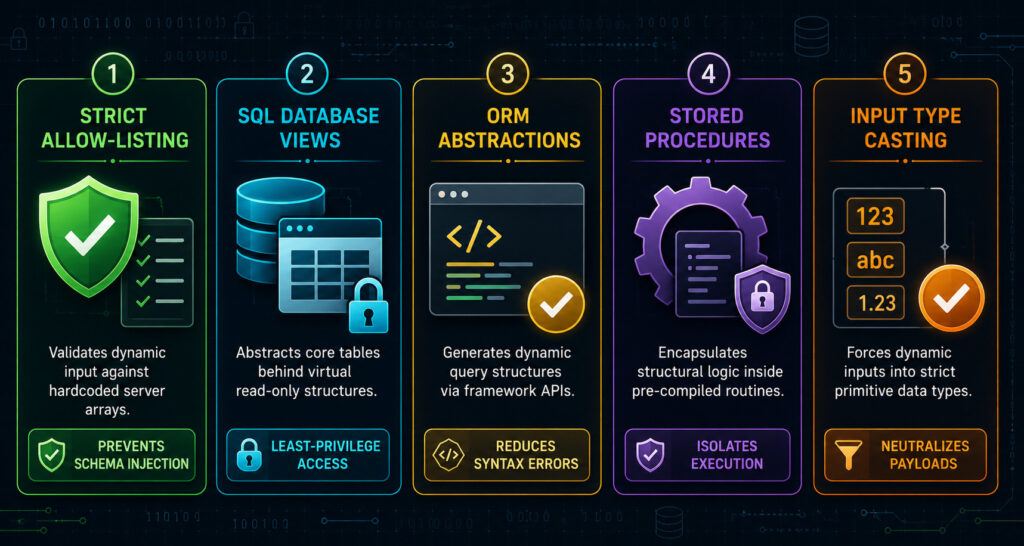
Alternative SQL injection prevention techniques often rely on strict structural validation rather than native parameter binding. When standard parameterized queries aren’t practical, developers can use allow-list validation and other safeguards to reduce the risk of malicious SQL statements. These methods work differently from parameterized queries for database security, which separate SQL commands from user-supplied values.
Database drivers frequently reject dynamic parameter markers. Developers must map all incoming API requests manually. They map inputs to static, trusted server-side variables before compiling queries. This deterministic mapping ensures structural safety. Only pre-verified schema identifiers enter the query execution engine.
Establishing these rigorous validation pipelines is essential. It neutralizes advanced payload injection attempts immediately. These threats are stopped before reaching the relational database management system. The comparison table below outlines the primary defense mechanisms available for dynamic query execution scenarios:
| Defense Mechanism | Execution Strategy | Primary Enterprise Security Benefit |
| Strict Allow-Listing | Validates dynamic input against hardcoded server arrays | Prevents arbitrary schema identifier injection natively |
| SQL Database Views | Abstracts core tables behind virtual read-only structures | Enforces absolute least-privilege data access boundaries |
| ORM Abstractions | Generates dynamic query structures via framework APIs | Reduces manual query syntax interpolation errors significantly |
| Stored Procedures | Encapsulates structural logic inside pre-compiled routines | Isolates execution boundaries from frontend application code |
| Input Type Casting | Forces dynamic inputs into strict primitive data types | Neutralizes string-based SQL manipulation payloads immediately |
Implementing these defense mechanisms ensures continuous operational stability. It protects highly concurrent enterprise database transaction clusters effectively.
What Structural Constraints Force Dynamic Execution Workarounds?
Alternative SQL injection prevention strategies are heavily necessitated by rigid compilation rules. Relational database engines govern these rules strictly. Relational database management systems must pre-compile structural logic. This generates optimized execution paths for server nodes. Consequently, engineers cannot bind schema objects dynamically.
Backend developers build dynamic reporting dashboards and complex analytical interfaces. They frequently encounter these strict compilation barriers. Native driver binding fails during structural query modifications. The backend application must inject trusted schema identifiers textually.
They use highly validated application routing logic to accomplish this securely.
Failing to validate these textual insertions introduces critical vulnerabilities. Automated application security testing tools flag these issues immediately. Official PostgreSQL engineering documentation explicitly defines these structural limitations. They mandate manual identifier validation routines:
“Parameter symbols can only be used for data values, if you want to use dynamically determined table or column names, you must insert them into the command string textually.” – PostgreSQL PL/pgSQL Dynamic SQL
Understanding native engine constraints is crucial. Enterprise architects design resilient data access layers accordingly. They avoid introducing critical architectural technical debt.
How Do Object-Relational Mappers Neutralize Backend Threats?
Object-Relational Mapping (ORM) frameworks can reduce SQL injection risks by handling much of the SQL generation behind the scenes. Many ORMs use parameterized queries by default, keeping data values separate from SQL commands without requiring developers to write every query manually.
However, ORMs don’t eliminate SQL injection risks entirely. Raw SQL queries, unsafe string concatenation, and improperly handled dynamic queries can still introduce vulnerabilities. Developers should follow their ORM’s security practices and review custom queries carefully to keep database interactions secure.
This reduces the risk of errors caused by manual string manipulation. Parameterized queries also help protect database operations by separating SQL commands from user-supplied values, as explained in how parameterized queries prevent SQL injection.
ORMs enforce strict object-oriented data access patterns. They physically prevent untrusted text strings from entering database interfaces. The framework handles complex dynamic query building natively. It translates application entity variables into safe execution parameters automatically.
Security operations teams must enforce strict developer guidelines. Developers must avoid utilizing the ORM’s raw query bypass features.
Executing native, unparameterized queries within ORMs is dangerous. It immediately reintroduces severe string interpolation vulnerabilities. Rigorous static application security testing pipelines are mandatory. They must actively block any deployment pull requests containing native bypass commands.
Standardizing data access through framework abstractions is highly recommended. It guarantees consistent security enforcement across massive microservice environments.
- Advanced ORM frameworks abstract manual string concatenation through secure database API functions.
- Framework-generated queries automatically utilize driver-level parameter binding for dynamic data streams.
- Strict code review policies must forbid unparameterized native ORM bypass queries entirely.
Why Are Bind Variables The Ultimate Defense Mechanism?
Credits: James Oliver
Alternative SQL injection prevention provides necessary architectural workarounds for dynamic schema execution. However, native parameter binding remains the absolute strongest defense. It secures standard transactional workloads effectively.
Enterprise backend security models prioritize native bind variables. They enforce a strict binary separation. This isolates executable logic from untrusted data streams perfectly.
Relational database management systems optimize execution plans based on static structural trees. This neutralizes payload execution vulnerabilities entirely. Engineering teams handle standard database manipulation operations daily. They must always default to native binary binding. Relying exclusively on secondary application validation routines is insufficient.
Enforcing this primary defense mechanism maximizes server transaction throughput. It also maintains zero-trust data access boundaries. Oracle’s official enterprise security documentation emphasizes this core architectural principle. It is required for secure PL/SQL environments:
“The most effective way to make your PL/SQL code invulnerable to SQL injection attacks is to use bind variables.” – Oracle SQL Injection Guidance
Are Allow-Lists Sufficient For Dynamic Sorting?
Parameterized queries protect data values, but they generally cannot bind column names or sort directions in an ORDER BY clause. When applications need dynamic sorting, developers should validate these inputs against a predefined allow-list of approved options.
If an API receives an unrecognized column name or sorting direction, the application should reject the request or use a safe default. Accepted inputs should map to hardcoded column identifiers and permitted directions, such as ASC or DESC, rather than being inserted directly into the SQL statement. This approach supports flexible sorting while reducing SQL injection risks.
This approach keeps dynamic sorting flexible while preventing user input from changing the query structure. Allow-listing works best alongside parameterized queries for data values and appropriate database permissions.
Failing to implement strict mapping protocols is highly dangerous. Malicious actors inject arbitrary schema operators into the execution sequence easily.
- Strict server-side allow-lists map untrusted user input directly to secure string variables.
- Fallback routing mechanisms ensure API endpoints execute securely despite malformed sorting parameters.
- Security operations teams must audit backend logic continually to verify schema column coverage.
How Do Abstraction Layers Protect Legacy Codebases?
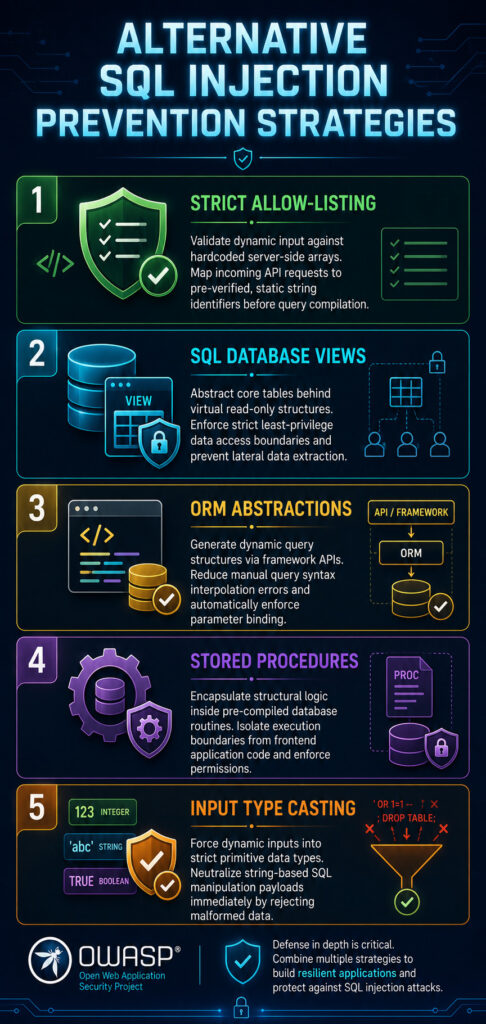
Legacy applications often lack consistent support for parameterized queries, making SQL injection prevention more challenging during modernization. Development teams may use database views to simplify query logic and restrict access to sensitive data. However, views alone cannot prevent SQL injection. They should be combined with parameterized queries where possible, strict input validation, and appropriate database permissions to strengthen protection.
Compiled stored procedures can also help protect database operations by encapsulating SQL logic, reducing the need for immediate changes across large application codebases. Their effectiveness depends on how queries are constructed and executed. Developers working across distributed architectures can also apply language-specific safeguards, including prepared statements in Java and PHP, to separate SQL commands from user-supplied data.
SQL database views operate as restricted read-only virtual tables. They explicitly prevent application service credentials from accessing raw schemas. External attackers compromise older dynamic query endpoints occasionally. The restricted database view physically prevents them from extracting lateral data.
This robust abstraction layer provides a crucial defensive operational buffer. Backend engineering teams utilize this buffer effectively. They systematically upgrade core application database drivers safely.
- SQL database views restrict data visibility and enforce strict least-privilege read access.
- Compiled stored procedures encapsulate execution logic to secure backend transactional structures.
- Layered security abstractions buy enterprise engineering teams critical refactoring time.
What constitutes an Alternative Sql Injection Prevention strategy?
These comprehensive strategies encompass secondary defense mechanisms. Examples include strict server-side allow-listing and mandatory input type casting. They also include restricted database views and advanced ORM abstractions. Backend engineering teams deploy these exact techniques specifically. They are used when rigid structural limitations prohibit standard native parameterized queries.
Why is strict allow-listing preferred over block-listing for dynamic queries?
Strict allow-listing explicitly defines all known-good structural values securely. It rejects any unexpected external input variations automatically at the routing layer. Block-listing attempts to predict all possible malicious payload patterns. This frequently fails against advanced attacker evasion techniques and complex character encodings.
Can relational SQL views completely prevent advanced SQL injection attacks?
Database views cannot prevent injection vulnerabilities directly. However, they drastically minimize the available enterprise attack surface. They enforce strict least-privilege access boundaries natively. If payload injection occurs within a restricted view context, damage is limited. Attackers remain physically unable to extract hidden underlying core tables.
How do modern ORM frameworks handle dynamic sorting requirements securely?
Modern Object-Relational Mapping frameworks utilize robust query builder APIs natively. They map dynamic frontend sorting requests to secure internal representations automatically. The mapping framework securely translates object properties into valid backend column identifiers. This entirely prevents raw, untrusted user strings from entering execution pipelines.
When should backend developers use input type casting for database security?
Mandatory type casting forces dynamic user input into strict primitive data types. Developers cast inputs as integers or booleans before query construction. A malicious actor might submit a string-based payload into an integer-casted variable. The application runtime throws a fatal exception, neutralizing the targeted attack immediately.
Implementing Comprehensive Database Defense Architectures
When native parameter binding isn’t available, development teams can use additional safeguards to reduce SQL injection risks. Allow-listing restricts dynamic identifiers to approved values, while secure framework abstractions help standardize query handling. Database views can also limit access to specific data, depending on how permissions are configured.
Combining these measures with parameterized queries wherever possible, appropriate database permissions, and the removal of unsafe string concatenation helps protect sensitive enterprise data. These layered defenses support more secure query execution without compromising legitimate application requirements. Performance should still be tested to ensure the chosen approach meets the system’s needs.
For practical guidance on secure coding and backend threat mitigation, join our secure coding bootcamp.
References
- https://www.postgresql.org/docs/current/plpgsql-statements.html
- https://docs.oracle.com/en/database/oracle/oracle-database/26/lnpls/sql-injection.html