


Building secure database applications starts with how queries are written. One way to reduce SQL injection risks is by avoiding dynamic SQL query construction that relies on raw string concatenation. Instead, developers can use parameterized queries to keep user input separate from executable SQL commands.
This approach helps protect sensitive data and reduces the risk of unauthorized database access. It can also make query handling more consistent under heavy workloads.
Keep reading to learn how to apply these practices in your database code.
Key Architectural Security Enhancements
Eliminating dynamic string concatenation stabilizes execution plans and enforces strict parameter boundaries.
- By avoiding dynamic SQL query construction, developers can handle user data more safely and reduce the chance of malicious input changing a query’s behavior.
- Pre-compiled routines eliminate repetitive parsing overhead during high-volume database transaction spikes.
- Structured access controls leverage native database driver binary binding mechanisms effectively.
Why is Raw Concatenation a Critical Vulnerability?
Dynamic query building merges untrusted input directly into executable SQL text. This fundamental flaw allows attackers to append arbitrary relational control characters. When database engines parse manipulated strings, they execute unintended relational commands.
Avoiding dynamic SQL query construction helps prevent attackers from manipulating query execution and accessing unauthorized data. Systems that rely on raw text interpolation remain vulnerable to SQL injection and potential data exfiltration. Automated security scanners often flag these patterns as critical security flaws.
Enterprise development standards mandate the complete removal of inline query building. Moving toward structured driver abstractions ensures consistent security across microservice environments.
How Do Pre-Compiled Plans Outperform Dynamic Queries?
Database performance relies heavily on query parsing and execution plan generation. Dynamic SQL forces the engine to compile a new plan for every request, highlighting the urgent need for parameterized queries for db security in enterprise systems. This repetitive overhead severely degrades transaction throughput during peak usage periods.
Avoiding dynamic SQL query construction enables databases to cache and reuse execution plans. The engine compiles the query structure once and binds variable parameters separately, reducing CPU overhead and helping maintain consistent backend latency.
| Evaluation Metric | Parameterized Execution | Dynamic Query Construction |
| Execution Plan | Cached and reused efficiently | Recompiled for every incoming request |
| Syntax Validation | Verified prior to runtime execution | Evaluated dynamically during execution |
| Injection Risk | Neutralized via binary parameter binding | High risk from string interpolation |
| CPU Overhead | Minimal overhead during execution | High parsing and compilation overhead |
How Does Parameterization Neutralize Injection Vectors?
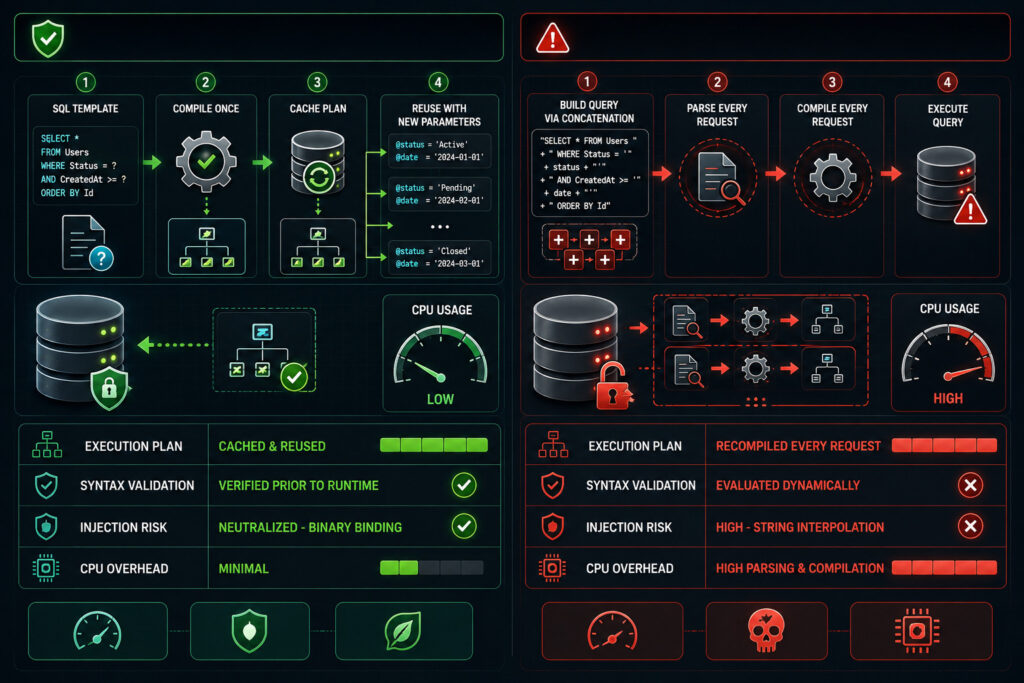
Parameter binding protocols transmit untrusted inputs separately from SQL command syntax, allowing database drivers to handle values independently of executable statements. By assigning inputs to predefined parameter placeholders, the database can distinguish data from SQL instructions and reduce the risk of injection attacks.
Avoiding dynamic SQL query construction strengthens this separation by using parameterized queries and native driver mechanisms to validate and safely process user inputs.
Microsoft engineers emphasize the architectural superiority of explicit parameterization strategies:
“Using parameterization gives you the advantage that you can clearly specify the data type and avoid pitfalls as well as the final T-SQL statement generated will reference the parameters as variables and not directly use the user defined input to generate the statement.” – Microsoft Dynamic SQL & SQL Injection Blog
How Can SQL Views Enhance Granular Access Controls?
Enforcing the principle of least privilege starts with clearly defined database access boundaries. Applications should not have direct read or write access to core tables. Instead, database views can expose only the specific rows and columns an application needs, reducing unnecessary data exposure.
Avoiding dynamic SQL query construction further strengthens this approach by limiting the risks associated with unsafe query generation. When access is restricted through views, applications interact only with approved data subsets rather than the underlying tables. This separation helps prevent compromised application credentials from accessing restricted records or exposing sensitive schema information.
The OWASP foundation highlights views as a primary defense-in-depth mechanism:
“You can use SQL views to further increase the granularity of access by limiting the read access to specific fields of a table or joins of tables.” – OWASP SQL Injection Prevention Cheat Sheet
What Are The Challenges of Legacy Migration?
Updating old code requires checking every part of the system that connects to the database. Older systems often use complex text commands to build SQL queries, which can create security risks. Replacing these commands with parameterized queries requires careful testing to confirm how parameterized queries prevent SQL injection.
Avoiding dynamic SQL query construction in large applications also requires a step-by-step plan. Teams can use Static Application Security Testing (SAST) to find security problems in the code. They can then use Dynamic Application Security Testing (DAST) to test the application and check how it handles unexpected inputs.
Modern Object-Relational Mapping (ORM) tools can make these changes easier by creating safer database queries automatically. However, developers still need to check custom SQL queries because these may not have the same built-in protections. Testing how the database driver handles query parameters is also necessary to meet security standards and compliance rules.
How Do ORM Frameworks Prevent String Interpolation?
Object-Relational Mapping (ORM) tools help developers work with databases without writing SQL queries by hand. They use objects and built-in methods to handle database tasks. When used correctly, these tools help developers avoid dynamic SQL query construction and reduce the risk of SQL injection.
- Avoid raw SQL when possible. Running SQL queries without parameters can create security risks, especially when user input is added directly to a query.
- Use built-in query features. ORM tools can create parameterized queries automatically, helping handle data types and user input safely.
- Review custom database code. Security teams should check the code to make sure developers do not bypass ORM protections with unsafe SQL commands.
Securing Backend Microservices Architecture
Credits: Professor Messer
Microservices work best when each service has its own database and access rules. Keeping data separate helps limit the damage if one service is attacked. Using safe query methods also helps prevent SQL injection and protects data across the system.
- Check code before release. Automated tools can flag unsafe SQL queries before developers add them to the main codebase.
- Manage database connections. Connection pools let services reuse database connections instead of opening new ones for every request.
- Improve query speed. Prepared statements can reduce repeated work for the database, helping services use resources more efficiently. Avoiding dynamic SQL query construction with unsafe user input also lowers the risk of SQL injection.
Handling Dynamic Sorting and Filtering Requirements
Applications often let users sort results or filter data based on their needs. Since database parameters cannot usually handle column names directly, developers should create a list of approved columns and sorting options.
Even when filters change, developers can keep queries safe by using prepared statements and approved column names. This approach is explained in using prepared statements in Java and PHP.
The application should reject any sorting option that is not on the approved list. This helps prevent unsafe input from changing SQL commands and reduces the risk of SQL injection.
Continuous Security Testing for Database Layers
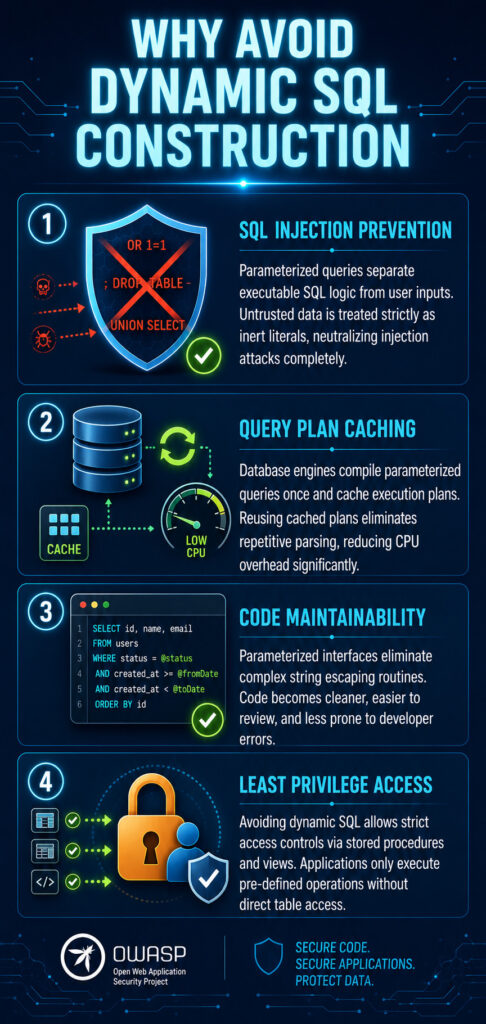
Automated security tests help teams find problems before releasing updates. Dynamic Application Security Testing (DAST) checks running applications with unexpected inputs to see how they handle them, including unusual characters.
Regular testing also helps catch old code that may bring back unsafe database queries. Regression tests can flag these problems before they reach production.
Security teams can also review database logs for unusual query patterns. These patterns may show that a query was built in an unsafe way. Finding these issues early helps teams fix weaknesses and respond to possible attacks.
FAQ
Why is Avoiding Dynamic Sql Query Construction critical for security?
Raw string concatenation allows attackers to alter the fundamental query logic. Using parameterized interfaces ensures inputs are treated strictly as inert data values. This isolation neutralizes injection vectors and stabilizes database query execution entirely.
How do execution plans optimize parameterized query performance?
Database engines compile parameterized queries once and cache the resulting execution plan. Subsequent requests reuse this plan by simply swapping memory variables. This eliminates repetitive parsing overhead and reduces overall server CPU consumption significantly.
Can Object-Relational Mapping frameworks completely prevent SQL injection?
ORM frameworks prevent injection when developers use standard object-oriented querying methods exclusively. Invoking native raw query functions within an ORM reintroduces severe security risks. Developers must enforce strict parameter binding even when utilizing advanced ORM features.
What role do SQL views play in database security architecture?
SQL views create restricted virtual tables exposing only necessary data subsets. They enforce the principle of least privilege by abstracting underlying core schemas. Compromised application accounts cannot query restricted data hidden behind authorized database views.
How do static analysis tools detect unparameterized database queries?
SAST scanners parse application source code to trace string variable concatenations. They flag instances where untrusted inputs flow directly into database execution functions. This automated scanning prevents insecure code from reaching production deployment pipelines.
Fortifying Database Architecture Against Injection Threats
Building a secure database starts with how applications handle SQL queries. Using parameterized queries helps prevent SQL injection by keeping user input separate from SQL commands. It can also reduce repeated work when the database runs similar queries.
SQL views add another layer of protection by limiting which data an application can access. Developers should replace unsafe string-based query building with safer methods to protect sensitive information and reduce security risks.
Want to learn more about database security and how to protect backend systems? Join our secure coding bootcamp today.
References
- https://learn.microsoft.com/en-us/archive/blogs/raulga/dynamic-sql-sql-injection
- https://cheatsheetseries.owasp.org/cheatsheets/SQL_Injection_Prevention_Cheat_Sheet.html#enhancing-least-privilege-with-sql-views