


Implementing parameterized queries ORM framework is essential for building resilient, high-throughput enterprise applications. At Secure Coding Practices, backend developers leverage modern Object-Relational Mapping tools to handle data abstraction without exposing database layers to SQL injection vulnerabilities.
ORM frameworks automatically convert literal input values into bound parameters, separating command logic from variable data. This structural isolation prevents malicious payload execution while enabling database engines to cache execution plans efficiently.
Adopting parameterized ORM patterns establishes an impenetrable security perimeter, simplifies database access code, and ensures long-term system maintainability across complex enterprise backend architectures.
ORM Abstraction Layers Enforce Automated Parameterization and Execution Speed
Automating database query construction through ORM parameter binding eliminates manual sanitization errors while optimizing server-side query processing.
- Implementing Parameterized Queries ORM Framework automatically separates SQL command structure from user variable inputs.
- Modern ORM engines bind literal values to database placeholders to prevent SQL injection vulnerabilities by default.
- Pre-compiled query structures generated by ORMs allow database servers to reuse cached execution plans for maximum throughput.
How Does Implementing Parameterized Queries ORM Framework Safeguard Enterprise Applications?
ORM frameworks simplify database interactions while helping teams maintain consistent security practices. Many modern ORM libraries use parameterized queries to keep SQL commands separate from incoming user data before passing statements to the database driver. This helps ensure that untrusted input is treated as data rather than executable SQL.
However, ORM frameworks don’t eliminate every SQL injection risk. Unsafe raw SQL, dynamic query construction, and improper handling of user input can still introduce vulnerabilities. Combining parameterized queries with appropriate validation and secure database permissions helps protect enterprise applications.
Beyond robust defense against injection attacks, utilizing an ORM layer simplifies database management across complex codebases. Instead of writing custom string escaping algorithms, developers rely on built-in object relational mappings that parameterize inputs automatically. This minimizes human error during feature development and accelerates time-to-market for enterprise software products.
Furthermore, parameterized ORM operations allow database engines to optimize statement compilation through cached execution plans. When queries use standardized parameter placeholders, database servers avoid re-parsing SQL statements for every unique user request. The resulting performance stability ensures consistent response times even under heavy application workloads.
What Distinguishes Automated ORM Parameterization From Raw SQL Concatenation?

ORM frameworks can simplify query construction by automatically parameterizing data values, reducing the need for developers to handle SQL statements manually. In contrast, raw string concatenation can introduce SQL injection vulnerabilities when untrusted input is inserted directly into a query.
With parameterized queries, the database treats supplied values as data rather than executable SQL. However, using an ORM doesn’t guarantee security if developers construct unsafe raw SQL or interpolate user input into queries. Teams should use parameterized operations wherever possible and review custom queries carefully.
Driver-level parameter binding helps protect enterprise data pipelines by separating SQL commands from user-supplied values. Understanding how parameterized queries for database security across backend systems work can help developers choose the right approach to handling database inputs securely.
Modern ORMs automatically convert object-level queries into prepared statements before dispatching them to the database driver. This automated translation ensures that input parameters are isolated from structural SQL logic throughout the query execution life cycle.
| Operational Aspect | Automated ORM Parameterization | Legacy Raw String Concatenation |
| Input Handling | Binds literal values directly to isolated parameter placeholders | Injects raw user strings directly into executable SQL statements |
| SQL Injection Risk | Zero; untrusted inputs cannot modify internal query logic | High; malicious strings can alter database command structures |
| Query Compilation | Pre-compiles statement templates to maximize execution plan caching | Re-parses unique statement strings repeatedly on every request |
| Developer Overhead | Handles parameter binding automatically via framework methods | Requires manual string sanitization and fragile escaping routines |
How Does API Standardization Complement ORM Parameterization?
Consistent API validation checks incoming data against expected formats, types, and constraints before processing. Combined with ORM parameterization, it adds another layer of protection by rejecting invalid input and keeping user-supplied values separate from SQL commands.
Combining standardized API validation with parameterized ORM operations creates multiple layers of defense. Validation checks whether input meets the application’s requirements, while parameterization keeps data values separate from SQL commands. Together with appropriate access controls and secure error handling, these practices help reduce vulnerabilities across backend services.
When enterprise applications accept incoming HTTP requests, standardizing API interface contracts ensures that parameter types are strictly validated before reaching database abstraction layers. Combining strict request schemas at the gateway with automated parameter binding in the ORM creates a defense-in-depth framework that prevents malformed data payloads from reaching persistent storage.
Standardizing external API definitions allows development teams to enforce strict type checking and input constraints across all application endpoints. By decoupling API interface contracts from specific programming languages, organizations maintain consistent validation rules across multi-service environments.
This structural consistency ensures that data inputs passed into ORM query builders conform to expected data types, further reducing edge-case vulnerabilities. Leading web interface standards emphasize the importance of language-agnostic API contract definitions across modern application stacks:
“The OpenAPI Specification defines a standard, programming language-agnostic interface description for HTTP APIs.” – OpenAPI Specification
How Do ORM Parameter Binding Mechanisms Isolate Untrusted Inputs?
By binding user-supplied values to query parameters instead of inserting them directly into SQL statements, ORM tools help isolate untrusted input. The query builder generates placeholders and passes the corresponding values separately to the database driver, reducing the risk of SQL injection.
This separation helps ensure that untrusted input is treated as data rather than executable SQL. However, protection depends on how the query is constructed. Developers should avoid unsafe string interpolation and raw SQL concatenation, even when working with an ORM.
Database drivers can separate SQL query structures from variable parameter streams, helping prevent user input from being interpreted as executable SQL. This separation allows the database engine to handle supplied values as data rather than SQL commands. The distinction is central to how parameterized queries prevent SQL injection in enterprise backend systems, where queries often process untrusted input.
Because the SQL template is compiled prior to parameter substitution, unexpected control characters or SQL keywords embedded in user payloads are rendered harmless. This structural boundary eliminates the risk of payload execution regardless of input complexity.
Automating this process through ORM libraries reduces developer workload and prevents security oversights during fast-paced software development cycles. Software engineering teams can enforce uniform database security rules without manually writing custom parameter binding logic for every unique endpoint.
- ORM query builders convert object parameters into bound database placeholders automatically.
- Binary transmission protocols isolate executable command syntax from untrusted variable streams.
- Pre-compiled query templates prevent malicious string inputs from modifying database execution logic.
How Does Controller Validation Prevent Malformed Data In ORM Mappings?
Credits: Pretty Printed
Parameterized queries help protect against SQL injection at the data access layer, but applications should also validate incoming data before it reaches the database. Modern web frameworks can check request bodies at the controller boundary, rejecting malformed payloads before mapping them to ORM entities.
These checks can enforce expected data types, required fields, length limits, and other business rules. Combining controller-level validation with ORM parameter binding helps prevent invalid data from entering persistence workflows while providing an additional layer of application security.
Combining automated DTO validation with ORM parameter mapping builds a multi-layered defense that keeps invalid or malicious payloads out of backend data pipelines. Validating input structures at the controller entry point prevents unverified fields from triggering unexpected database mapping exceptions or resource-heavy transaction processing.
When an incoming JSON payload violates defined schema rules, the web framework intercepts the request and terminates execution immediately. This early rejection pattern reduces processing overhead and prevents invalid parameter values from reaching downstream ORM query builders.
Leading Java web framework specifications explicitly define how automated controller validation handles schema violations before executing business logic:
“By default, validation errors cause a MethodArgumentNotValidException, which is turned into a 400 (BAD_REQUEST) response.” – Spring MVC Request Body Validation Documentation
Can ORMs Optimize Query Performance?
ORM frameworks can support query performance by generating parameterized SQL that may allow database engines to reuse execution plans for repeated queries with different values. Depending on the database engine, driver, and configuration, this can reduce parsing and planning overhead.
However, plan caching and reuse aren’t guaranteed for every query, and ORM use doesn’t automatically make database operations faster. Developers should measure performance under their actual workloads and review generated SQL, indexing, and query patterns to identify potential bottlenecks.
This process eliminates redundant statement parsing, minimizes database memory fragmentation, and stabilizes throughput during peak system traffic.
- Pre-compiled ORM templates allow database parsers to reuse cached execution plans automatically.
- Binding literal parameters to pre-compiled handles cuts CPU utilization across high-traffic API workloads.
How Do Enterprise Frameworks Automate Parameter Binding Across Languages?
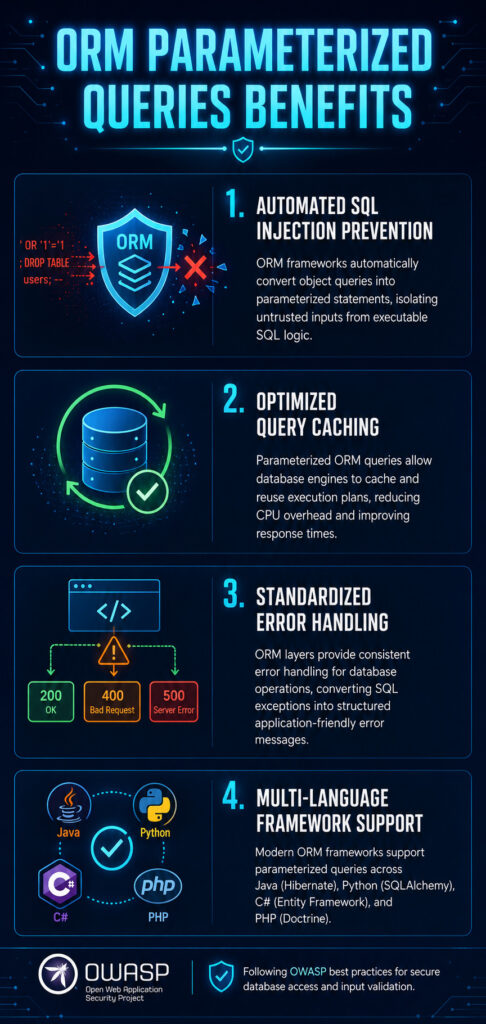
Across languages such as Java, C#, Python, and PHP, ORM tools simplify database access and often handle parameter binding automatically. They allow developers to pass data values separately from SQL commands, reducing reliance on string concatenation and helping prevent SQL injection.
The exact implementation depends on the ORM, driver, and query method used. While many standard ORM operations use parameterized queries by default, raw SQL and dynamically constructed queries still require careful handling to avoid SQL injection. Teams should review how their chosen framework handles parameters and follow its security recommendations.
ORM abstraction layers help separate user input from database commands, reducing the risk of SQL injection in enterprise applications. Frameworks that support prepared statements in Java and PHP allow developers to bind values safely instead of inserting raw input directly into SQL queries.
The ORM framework binds variable parameters to pre-compiled statement handles at runtime, maintaining an unbreakable boundary between executable code and untrusted data streams. This uniform implementation reduces technical debt, minimizes configuration overhead, and guarantees consistent database security controls across microservices.
Establishing automated ORM parameterization policies ensures long-term backend security and maximum performance stability across growing development teams.
- Enterprise ORM frameworks replace manual SQL construction with standardized, driver-level parameter binding.
- Pre-compiled statement handles eliminate character encoding bypasses and injection vulnerabilities across multi-language runtimes.
- Automated parameterization streamlines code maintenance and enforces compliance standards across distributed enterprise architectures.
FAQ
What is the primary benefit of Implementing Parameterized Queries ORM Framework?
The main advantage is automated SQL injection prevention combined with optimized database execution. ORM frameworks separate SQL command structures from untrusted variable inputs, ensuring that user data is evaluated strictly as literal values while enabling database servers to reuse cached query execution plans.
Does using an ORM completely eliminate SQL injection risks?
While ORM frameworks parameterize standard model methods automatically, vulnerabilities can still occur if developers execute raw SQL queries or concatenate strings inside native query methods. Engineering teams must avoid manual string formatting within ORM raw query functions to maintain complete parameter isolation.
How does ORM parameter binding improve database server performance?
Parameterized ORM queries allow database parsers to compile SQL templates once and reuse the compiled execution paths for subsequent requests. This reduces server CPU consumption, decreases memory fragmentation, and accelerates response times across high-concurrency API endpoints.
Do all modern ORM frameworks support parameter binding by default?
Yes, leading ORM frameworks such as Hibernate, Entity Framework, SQLAlchemy, and Prisma enforce parameter binding by default across standard data access operations. They convert object-level queries into parameterized statements before sending data packets over the network to the database driver.
Should controller input validation still be used if an ORM is implemented?
Yes, controller-level validation is essential for defense-in-depth architecture. Validating request payloads at the API entry point rejects malformed or invalid inputs early, preventing unnecessary transaction processing and reducing load on the underlying ORM and database layers.
Securing Data Access Layers With Automated ORM Parameterization
from user-supplied data. When applications construct queries through unsafe string concatenation, they risk SQL injection vulnerabilities.
Many ORM operations use parameter binding to treat input as data rather than executable SQL. Depending on the database engine and configuration, parameterized queries may also support execution plan reuse, though performance improvements aren’t guaranteed in every case. Developers should review raw SQL and dynamic query construction carefully, even when using an ORM.
Consistent parameter binding across application services helps reduce SQL injection risks and strengthen database security. For practical guidance on secure coding and backend protection, join our secure coding bootcamp.
References
- https://spec.openapis.org/oas/
- https://docs.spring.io/spring-framework/reference/web/webmvc/mvc-controller/ann-methods/requestbody.html