


Choosing the right input validation libraries python examples can make the difference between software that merely accepts data and software that actively protects itself from bad input. Many developers focus on validating formats and types, but secure applications require a broader approach that prevents unexpected data from influencing business logic.
At Secure Coding Practice, we’ve seen how effective validation reduces bugs, strengthens security, and improves maintainability. Understanding the strengths of different Python input validation libraries examples is the first step toward building safer systems. Keep reading.
Validation Habits That Strengthen Security
Input validation is most effective when it becomes a core part of application design rather than a last-minute feature. The following principles help create more reliable and secure Python applications:
- Validation must happen at the system boundary, where data enters.
- Combining type hints with runtime validation catches more errors.
- Your validation logic should be independent of any single framework.
What are the core types of Python validation libraries?
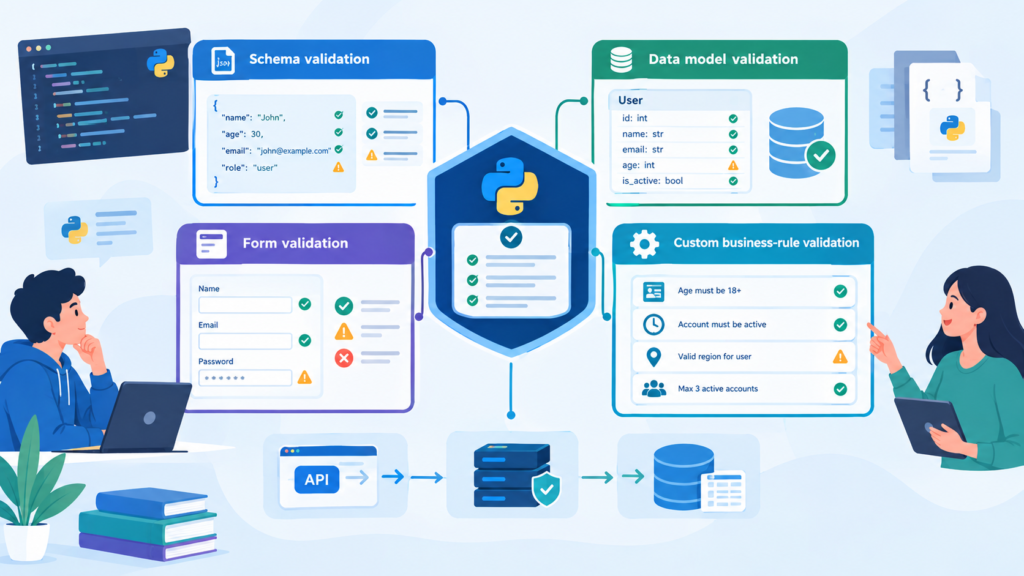
They generally fall into two camps. Schema validators and function-based validators. Schema validators let you define a template or model that your data must fit, like a mold. Function-based validators give you tools to write custom checks, step by step. Each has a different feel, a different philosophy on how to handle the messiness of user input.
We leaned heavily on schema validators for a long time. You define a class, annotate the types, maybe add some field constraints. It feels clean. The data either conforms or it doesn’t. But we found they can be rigid.
When a piece of data needed a complex, conditional check based on another field’s value, the schema sometimes fought us. The structure wanted simplicity where our problem had nuance.
Function-based libraries offered that nuance. They’re more like writing a recipe: check this, then that, then transform this other thing. It’s powerful, but it’s easier to make a mess.
You can end up with validation logic scattered across different functions, losing the clear contract a schema provides. The choice isn’t about which is better. It’s about which approach aligns with how your application thinks about its data.
How do schema validation examples improve code safety?
They make your data’s shape explicit and enforceable. When you use a library that supports Python type hints, you’re not just validating for the current function call. You’re creating a documented contract that any developer can read. The code tells you what it expects, right there in the class definition.
Consider a user registration form. Without a schema, you might get a dictionary from your web framework. You hope it has email and password keys. You write some if statements. It works, but it’s fragile. With a schema, you define a UserRegistration model. email: str, password: str.
“When building secure software, allowlisting is the recommended minimal approach. Denylisting is prone to error and can be bypassed with various evasion techniques and can be dangerous when depended on by itself.” – GeeksForGeeks
The validation library parses the incoming dict into an instance of that model. If the dict doesn’t match, you get a clear, structured error immediately. The invalid data never penetrates your core logic. This is one reason many teams adopt input validation frameworks to establish consistent data contracts across an application.
This practice of defining a strict schema at the point where external data enters your system is a cornerstone of secure coding. We call it “validation at the boundary.” It means untrusted data is forced into a known, good shape before your business logic ever touches it.
When should you use function-based validation instead?
When your rules are dynamic or involve complex relationships between fields. A schema is great for static structure. But what if the validation for a “discount_code” field depends on the value of the “country” field? Or if you need to validate that a “start_date” is before an “end_date”? This is where function-based validation shines.
You can write a validator function that receives the entire data packet. It has the freedom to inspect any field, call out to a database, or perform multi-step logic. It’s more procedural, which gives you flexibility.
We used this for a compliance form where the required fields changed based on the user’s selected product type. A static schema would have been incredibly complex. A single validation function could handle the logic clearly.
The risk, of course, is complexity creep. That one function can become a giant, tangled mess. The key is to keep these validators focused. Write small functions that check one specific condition. Then compose them together.
A library that supports this composition helps you keep the power without the spaghetti code. It’s a tool for those gray areas where data rules are more like business guidelines than hard structural constraints.
What does a layered validation strategy look like in practice?
It means validating the same data more than once, for different reasons, at different layers. A single check is rarely enough. You validate at the API endpoint for format and type. You validate in your service layer for business rules.
Many of the practical advantages come from treating the validation framework as just one layer in a broader security strategy rather than the entire solution.
Think of it as a series of filters, each with a finer mesh.
- Layer 1: Syntax/Format. Done at the API with your validation library. Is it a string? Is it a valid email format?
- Layer 2: Business Logic. Done in your service functions. Does this email belong to an existing user? Is this user allowed to perform this action?
- Layer 3: Contextual Safety. Done at the point of use. For SQL, use query parameters. For HTML, escape the output.
This table shows how responsibilities split between tools and practices:
| Validation Layer | Library’s Job | Your Secure Coding Practice |
| Data Entry Point | Parse & shape raw input into models. | Reject all data that doesn’t fit the exact expected model. |
| Core Business Logic | Minimal. Models are already typed. | Enforce stateful rules (user permissions, workflow state). |
| Output Encoding | None. | Always encode/escape for the target (SQL, HTML, shell). |
We learned this the hard way on an internal admin tool. The API validation was perfect. But a service function directly interpolated a validated username into a shell command for a legacy script. The validation ensured it was a string, but didn’t escape shell metacharacters. A username with a semicolon could execute arbitrary commands.
Can you combine type hints with runtime validation effectively?
Credits: Learning With Rodo
Absolutely, and you should. Modern Python encourages it. Type hints give you static analysis. MyPy or Pyright can look at your code and warn you if you’re trying to pass an integer where a string is expected.
This catches bugs early, in your editor, before the code even runs. But it’s a development-time check. It doesn’t exist at runtime when your application is live and receiving real user data.
Runtime validation is what enforces those types when the program is executing. A good validation library will respect your type hints. You define a field as age: int, and the library will try to cast incoming data to an integer and raise an error if it can’t.
This gives you the best of both worlds: developer confidence from static checks and runtime safety from validation.
We configure our projects to use both aggressively. Linters enforce type consistency across the codebase. Then, at every API endpoint or data ingestion point, we use a library that performs runtime validation based on those same type hints. This creates a strong, consistent data contract from the front of the request all the way through the system.
What are common pitfalls in Python validation examples?
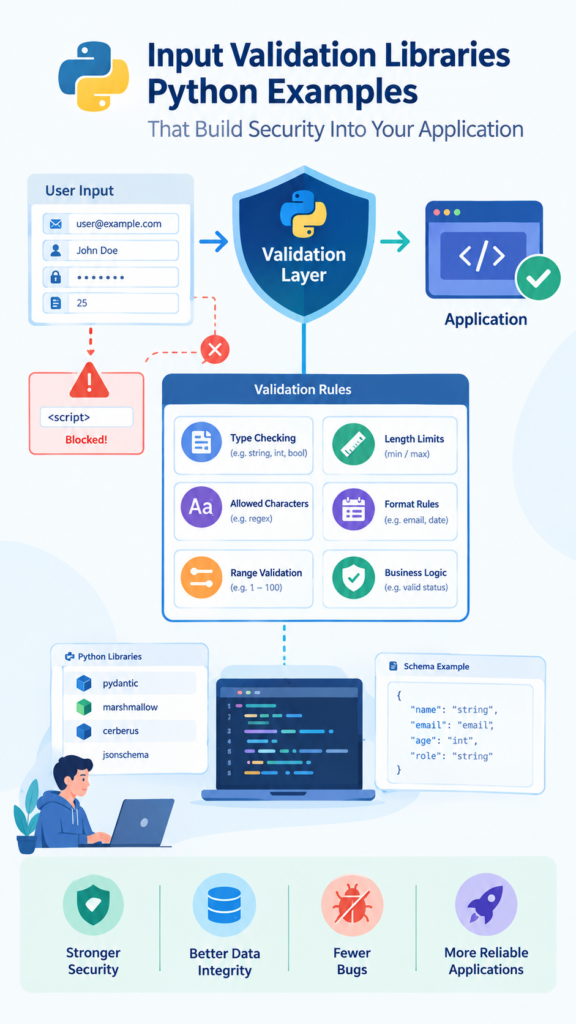
The biggest one is trusting validated data implicitly. You validate it once at the start and then assume it’s safe forever. But data has context. A string validated for a username is safe for a database query if you use parameterization. That same string is not safe to print directly into an HTML page without escaping. The validation library doesn’t know the destination.
Another pitfall is missing the boundary. Developers often validate data deep inside their application logic, after it’s already been processed by several functions. By then, it’s too late. Invalid data has already polluted your system’s state.
“Input validation does not always make data ‘safe’ since certain forms of complex input may be ‘valid’ but still dangerous. For example, a valid email address may contain a SQL injection attack or a valid URL may contain a Cross Site Scripting attack.” – ReadMedium
Validation must be the very first thing that happens, the moment you receive data from an untrusted source (which is any external source). This is a secure coding practice, not a library feature.
We also see overly permissive schemas. A field is defined as Optional[str] because “it might not come from the frontend.” But if your business logic requires that field, making it optional just pushes the null-check problem deeper into your code. It’s better to be strict at the boundary. Force the frontend to send the correct data.
How do you integrate validation with FastAPI or Django?
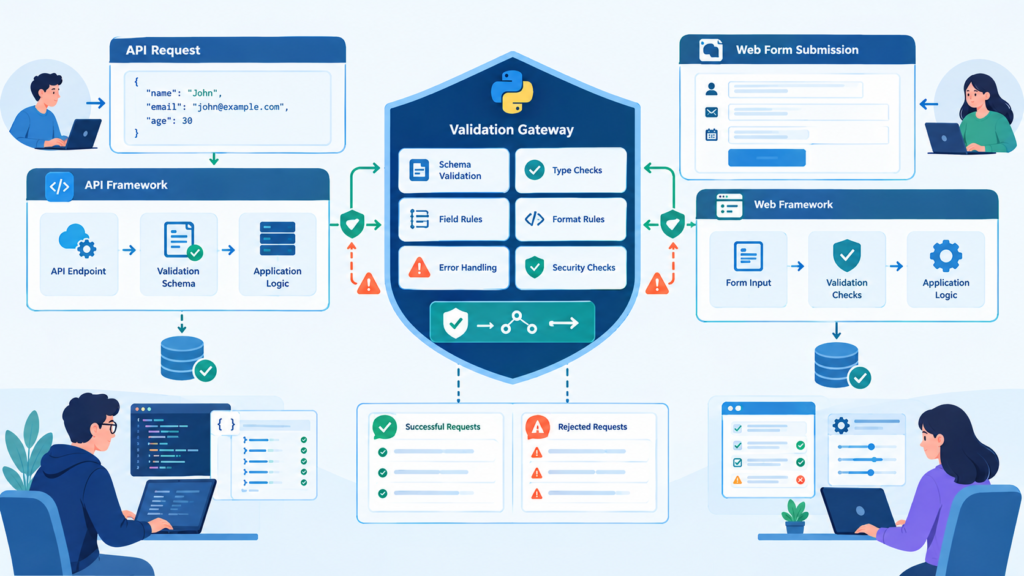
The integration is different because the frameworks have different philosophies. FastAPI is built with Pydantic (a validation library) at its core. Validation is not an integration, it’s the foundation. You define Pydantic models for your request and response bodies.
FastAPI automatically uses them to validate incoming JSON, generate OpenAPI docs, and produce clear error messages. It’s incredibly seamless. The validation is the API definition.
Django is more monolithic. It has its own form system for validation. It’s powerful and deeply integrated with the ORM and templates. For validating API requests (with Django REST Framework), you use serializers, which are Django’s flavor of a validation schema. The pitfall here is fragmentation.
The choice of web framework can steer your choice of validation library. With FastAPI, you’re almost certainly using Pydantic. While implementation details differ between ecosystems, the underlying goals of modern input validation frameworks remain remarkably similar.
FAQs
Is input validation enough to prevent SQL injection?
No, never. Validation is a complementary practice. The only sure way to prevent SQL injection is to use parameterized queries or your ORM’s query builder. Validation can help by ensuring data is roughly the right format, but you must always separate SQL code from data. This is a non-negotiable secure coding practice.
Do I need a validation library if I’m using Python type hints?
Yes, you do. Type hints are for static analysis and developer tooling. They are not enforced at runtime. A user can still send a string where an integer is expected. A runtime validation library ensures the live data conforms to the types your code expects, providing runtime safety that static hints alone cannot.
How does validation impact API performance?
There’s a cost, but it’s minimal and almost always worth it. The performance hit of parsing and validating a JSON body is tiny compared to the cost of processing bad data, triggering database errors, or dealing with a security breach. Validate early and fail fast. The slowest API is one that processes requests halfway before crashing.
Can I validate file uploads with these libraries?
Yes, but it’s different. For files, you’re less validating content and more validating metadata: file size, extension, and MIME type. Some libraries can help with this, but often you’ll use framework-specific features (like FastAPI’s UploadFile) alongside custom logic to check file signatures for extra security, not just trusting the filename.
Building Unbreakable Input Pipelines
Input validation is not about checking boxes or choosing the most popular library. It is about creating predictable, trustworthy data flows that protect every layer of your application. Whether you prefer schema-based models, function-based validators, or a combination of both, the goal remains the same: reject bad data early and enforce clear boundaries.
At Secure Coding Practice, we encourage developers to treat validation as a security control, not a convenience feature. Explore more Secure Coding Practice resources to strengthen your Python applications and build safer software from the ground up.
References
- https://www.geeksforgeeks.org/python/input-validation-in-python/
- https://readmedium.com/the-best-input-validation-libraries-for-python-developers-eba23c9cf2b6