


Secure code development training helps software engineers identify, prevent, and fix vulnerabilities throughout the software development life cycle (SDLC). However, 53% of developers say their organizations do not provide secure coding training, according to the OpenSSF Security Education Plan. This gap leaves development teams exposed to avoidable security risks. Compliance videos alone rarely change how developers write code.
Effective training needs hands-on exercises, threat modeling, and automated security feedback that developers can apply to real projects. Secure Coding Practices helps organizations strengthen these skills and build safer coding practices. Keep reading to learn how to improve your developer security training.
Secure Coding Training: Essential Lessons at a Glance
Secure coding training teaches developers how to stop security flaws. It helps them write better code and build safer apps at every step of development.
- Secure coding training helps developers spot and prevent common security flaws.
- Hands-on practice is more useful than relying on videos alone.
- Security checks should be part of everyday development work.
- Teams should measure training through code quality and security results.
- Ongoing learning helps developers keep up with new threats.
Why Secure Code Development Training Matters?
Software vulnerabilities can expose customer data, disrupt services, and damage a company’s reputation. Many of these issues begin with small coding mistakes, such as weak input checks, poor access controls, or unsafe handling of sensitive information.
Developers play a key role in preventing these problems. They make decisions about how data is stored, processed, and shared. Without security knowledge, even experienced developers can introduce weaknesses into an application.
Research from OpenSSF and Linux Foundation shows
“53% of practitioners have not taken a secure software development course, with 44% citing lack of awareness of quality training as the primary reason.” – Linux Foundation
Secure code development training gives teams the skills to make safer choices from the start. Effective secure coding training for developers also helps developers understand why certain coding practices matter, rather than simply asking them to follow rules.
The goal is not to make every developer a security expert. It is to help them recognize common risks, write safer code, and know when to ask for support.
What Are the Core Secure Coding Practices Every Developer Should Know?
Secure coding practices training should focus on practical habits developers can use across projects and programming languages.
| Practice | Why it matters |
| Validate input | Helps prevent unexpected or harmful data from reaching an application |
| Use safe authentication | Protects accounts and limits unauthorized access |
| Apply access controls | Ensures users can only reach the data and features they need |
| Protect sensitive data | Reduces the risk of exposing passwords and personal information |
| Handle errors safely | Prevents error messages from revealing private system details |
| Keep dependencies updated | Helps address known weaknesses in third-party software |
For example, developers should check user input before using it in database queries. They should also use parameterized queries instead of joining strings to build SQL statements. This lowers the risk of SQL injection.
Training should explain the risks behind each practice. It should also give developers time to practice what they learn. Realistic exercises help them remember these lessons when working on live projects.
How Can You Make Security Part of the Software Development Life Cycle?

Security works best when teams consider it throughout the software development life cycle, not only before release.
During planning, teams can discuss possible threats and decide what needs protection. During design, they can review system architecture and access controls. While coding, developers can follow secure coding standards and use automated checks.
Testing should include security checks. Look for weak logins, unsafe input handling, and exposed data. Before release, teams should fix key issues and confirm that the fixes work.
This method is often called “shifting security left.” It means catching and fixing problems early, when changes are easier and cost less.
Security must also continue after release. Teams need to watch live applications, update dependencies, fix new security flaws, and learn from past incidents.
How Can You Use Hands-On Exercises to Build Skills?
Developers learn secure coding by doing it. Training should include practical tasks that reflect the problems they may face at work.
Useful exercises include:
- Finding and fixing SQL injection flaws.
- Improving authentication and password handling.
- Identifying insecure direct object references.
- Reviewing code for exposed secrets.
- Fixing errors found by security testing tools.
A good training exercise starts with insecure code. First, ask developers to find the flaw. Next, walk them through a safer fix. Trainers should explain why this fix works. They should also explain the risks of leaving the bug in place.
When you can, use examples from the team’s own tech stack. For instance, a developer who writes JavaScript will learn best from JavaScript exercises that use their daily frameworks.
How Can You Choose the Right Training Format?
There is no single training format that works for every team. The right secure coding training programs depend on developers’ experience, available time, and the risks facing the organization.
| Training format | Best use |
| Instructor-led workshops | Guided practice and team discussion |
| Online courses | Flexible learning at an individual pace |
| Secure coding labs | Finding and fixing realistic vulnerabilities |
| Code reviews | Applying security lessons to real projects |
| Short refresher sessions | Reinforcing skills and sharing new risks |
A blended approach often works well. Teams can combine short lessons with practical labs, code reviews, and regular discussions. This gives developers a chance to learn a concept, practise it, and use it in their daily work.
Training should also match each developer’s role. New team members may need help with basic security principles. In contrast, experienced engineers may get more value from advanced topics. These include threat modeling, secure architecture, and dependency risks.
How Can You Use Security Tools to Support Developer Training?
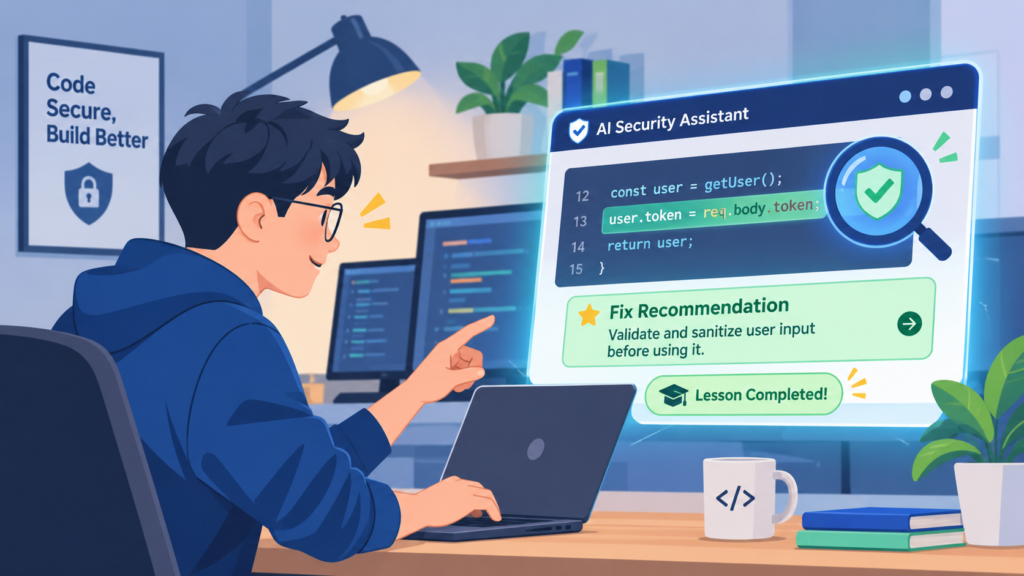
Security tools help developers find weaknesses while they work. They do not replace training, but they can turn security lessons into regular development habits.
Three common types of tools are:
- Static Application Security Testing (SAST): Checks source code for possible security issues without running the application.
- Dynamic Application Security Testing (DAST): Tests a running application to find weaknesses that may appear during use.
- Software Composition Analysis (SCA): Checks third-party libraries and dependencies for known vulnerabilities.
Each tool has a different purpose. Using more than one can give teams a broader view of application risk.
Developers also need to understand how to read and respond to the results. A tool may report a possible issue that needs further review. Training helps developers decide which findings matter, investigate the cause, and make the right fix.
The aim is to make security feedback useful and timely. When developers receive clear guidance during their normal workflow, they can address problems before they reach production.
How Can You Teach Developers to Think About Threats?
Threat modeling helps teams think about how an application could be attacked before those attacks happen.
Developers can start by asking a few simple questions:
- What data or systems need protection?
- Who might try to access them?
- How could someone misuse the application?
- What controls could reduce those risks?
For example, an online store may need to protect customer accounts, payment details, and order records. A threat modeling exercise could explore what might happen if a user changes an order ID in a web address to view someone else’s order.
This discussion helps developers understand why access checks must happen on the server, rather than relying only on what the user can see on the screen.
Threat modeling does not need to be complicated. Short sessions during planning or design reviews can help teams identify risks and agree on practical safeguards.
How Can You Build a Long-Term Secure Coding Training Plan?
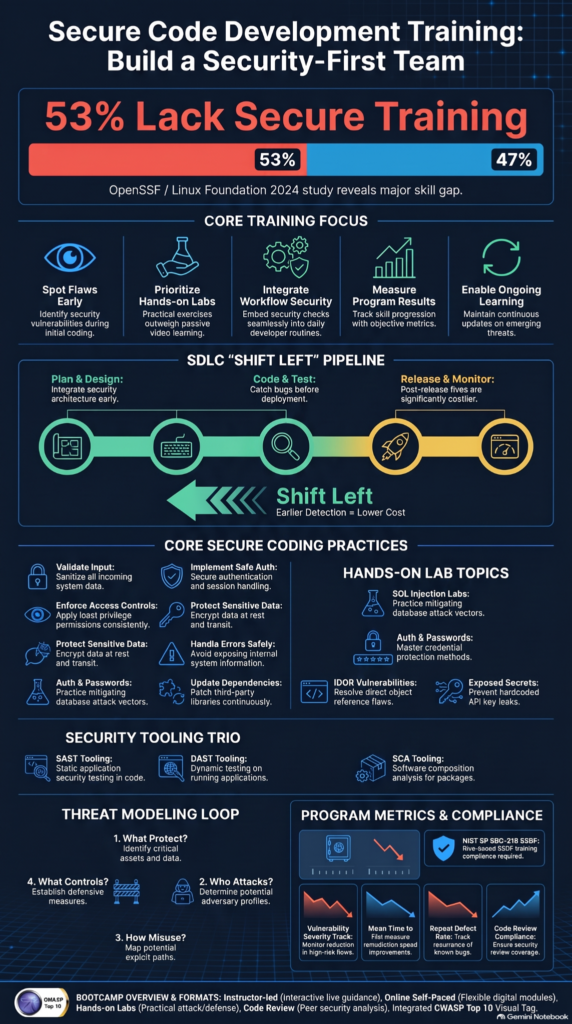
A single workshop is unlikely to change how a team works for good. Developers need regular opportunities to practise, review, and improve their skills.
As highlighted by NIST
“NIST SP 800-218 (SSDF) explicitly requires organizations to provide role-based training for all personnel involved in secure development, and to periodically assess proficiency and update training content.” – NIST SP 800-218 (SSDF)
A simple training plan can follow these steps:
- Assess current skills. Find out what developers already know and which security topics need attention.
- Set clear learning goals. Focus on risks that matter to the team’s applications and technology.
- Provide practical training. Combine short lessons with coding exercises and guided labs.
- Apply the learning. Use code reviews, security testing, and team discussions to reinforce good habits.
- Review progress. Check results and update the training plan as risks and technologies change.
Keep the plan realistic. Short, regular sessions may be easier to fit into busy development schedules than a long course that developers complete only once.
Managers should also give developers time to learn and fix security issues. Training is less effective when teams are expected to meet delivery deadlines without time for secure development work.
How Can You Measure Whether Training Is Working?
Completing a course does not prove that developers can apply what they learned. Organizations should look at changes in development practices and security results.
Useful measures include:
- The number and severity of vulnerabilities found in code.
- How long it takes to fix security issues.
- How often the same types of weaknesses appear.
- Whether developers follow secure coding standards during code reviews.
- How well developers perform in practical security exercises.
No single measure tells the whole story. For example, an increase in reported vulnerabilities may mean that testing has improved, rather than that the code has become less secure.
Review results over time and consider the context behind them. The purpose is to identify where teams need more support, not to blame individual developers.
What Are the Common Mistakes in Secure Coding Training?
Credit: TechInFive
Even well-planned training can fall short if it does not reflect how developers work.
Relying only on theory: Presentations explain security concepts. However, developers also need hands-on practice to find and fix vulnerabilities.
Using examples that do not match the team’s work: Training is hard to apply when exercises use unfamiliar languages, tools, or frameworks.
Treating training as a one-time task: Security risks change often. Because of this, developers need regular updates and practice.
Ignoring the development process: Training will not help much if teams lack time, clear standards, or the right tools to use what they learn.
Measuring attendance instead of results: Tracking who finishes a course is helpful. Even so, it does not show if coding habits have actually improved.
Avoiding these mistakes helps make security part of daily work instead of an extra chore for compliance.
FAQs
What skills should I develop through secure code development training?
Secure coding training teaches developers to find and stop security risks while writing software. The best courses cover practical topics. These include safe coding methods, input checks, output encoding, and threat modeling. They also teach developers about common software flaws and how to review code for safety. Hands-on exercises let developers practice on real code. This helps them fix issues before software goes live.
How can developers prevent common application security vulnerabilities?
Developers can stop common security flaws by following safe coding rules. They should also run checks as they build software. Training needs to teach them how to prevent SQL injection, cross-site scripting, and CSRF. It should also cover user logins, access controls, and secure session management. These skills help developers spot weaknesses and reduce the risk of successful attacks.
Why should developers learn OWASP secure coding practices?
OWASP secure coding practices teach developers about common software risks and how to prevent them. Helpful guides include the OWASP Top 10, OWASP ASVS, and OWASP Proactive Controls. These resources offer clear advice for building safer apps. With them, developers can find weak spots, improve security, and follow reliable coding standards.
How can I check whether my code follows secure coding standards?
You can check your code in three ways: secure code reviews, automated security tests, and manual vulnerability checks. Training helps developers spot unsafe coding habits during reviews. Tools like SAST, DAST, and software composition analysis can find potential weaknesses. Routine testing also helps teams find vulnerable dependencies and fix problems before releasing software.
How can I measure the effectiveness of developer security training?
You can measure developer security training in a few ways. Look at vulnerability trends, fix times, and security test results. Check how developers perform in hands-on exercises. Track repeat coding mistakes and issues found during code reviews. These metrics highlight knowledge gaps. They also show whether developers use secure coding practices while building software.
How Can You Make Secure Coding a Shared Responsibility?
Developers have an important role in application security, but they should not carry the responsibility alone. Security teams, engineering managers, and business leaders all need to support the work.
Security teams can provide guidance, review complex risks, and help create useful training materials. Engineering managers can make time for training and include security in project planning. Developers can apply secure coding practices, raise concerns, and share lessons with their teams.
Organizations should also make it easy to ask questions. Developers are more likely to address security concerns when they know where to get help and do not fear being blamed for reporting a problem.
A strong security culture grows through shared effort, clear expectations, and regular practice.
Build Safer Software with Practical Secure Coding Training
When security issues surface late in development, your team can lose time fixing problems that better coding habits could have prevented. A course alone won’t change that.
The Secure Coding Practices Bootcamp gives developers practical, hands-on training in secure coding, including the OWASP Top 10 and safer ways to handle common risks. Delivered live online or in person over two days, it helps your team put those skills to work. Explore Secure Coding Practices Bootcamp and join.
References
1. “Secure Software Development Education 2024 Survey: Understanding Current Needs.” The Linux Foundation, June 2024. Accessed November 11, 2026.
2. “SKILL.md (PO.2.2 – Provide Role-Based Training).” GitHub. Accessed November 11, 2026.