


Secure coding training teaches developers to prevent, find, and fix software flaws. This training protects software at every stage of development. A strong program includes hands-on practice, lessons tailored to specific roles, security standards, and real-world tests..
Secure Coding Practices helps organizations train developers to write safer code. It also helps them manage real security risks. NIST recommends including security in everyday development work. Teams should not treat it as a separate task. This guide covers how to plan training, deliver relevant lessons, and measure results. Keep reading to learn how to build a program that improves software security.
Secure Coding Training: What You Need to Know
Secure coding training helps developers build safer software. It turns security knowledge into everyday skills. Programs should combine hands-on practice, regular tests, and ongoing improvement. Doing this helps reduce mistakes during development.
- Stop security issues early. Help developers find, avoid, and fix flaws using hands-on practice and continuous training.
- Build practical security skills. Use hands-on lessons and courses for specific coding languages. Add secure code reviews so developers can use safe practices on real projects.
- Measure training results to see how well the program works. You can track developer assessment scores and look for recurring vulnerabilities. It also helps to check how long fixes take and review security testing results.
What Makes Secure Coding Training Programs Effective?

Effective secure coding training connects security lessons to everyday development work. Developers learn to spot weaknesses, write safer code, and test their fixes.
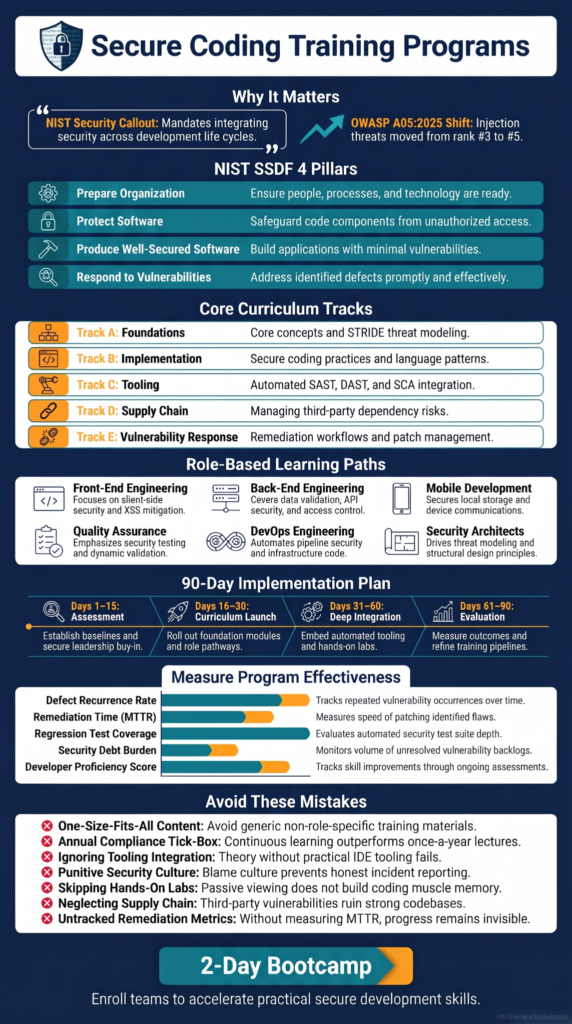
The NIST Secure Software Development Framework shares four key recommendations. First, prepare your teams. Second, protect your software. Next, build secure applications. Finally, respond quickly to vulnerabilities. It also highlights role-based training and regular skill reviews.
As highlighted by NIST
“Few software development life cycle (SDLC) models explicitly address software security in detail, so secure software development practices usually need to be added to each SDLC model.” –NIST
That’s why we teach more than coding rules. Our bootcamp focuses on practical skills. You will learn to review vulnerable code and fix security flaws. You will also learn about the risks of using outside libraries. Developers build stronger habits when they can put each lesson into practice.
A successful program should help developers:
- Spot common language and framework weaknesses.
- Fix vulnerabilities and test their solutions.
- Apply secure coding standards.
- Recognize risks in third-party components.
- Use security skills during code reviews and daily tasks.
Why Do Organizations Need Secure Coding Training for Developers?

Secure coding training helps organizations prevent vulnerabilities that can expose data, disrupt services, and raise repair costs. Teaching developers to spot risks early makes security part of everyday work.
1. Reduce Common Application Vulnerabilities
Research from OWASP shows
“A05:2025 – Injection falls two spots from #3 to #5 in the ranking. Injection includes a range of issues from Cross-site Scripting (high frequency/low impact) to SQL Injection (low frequency/high impact) vulnerabilities.” – OWASP
2. Improve Development Quality and Remediation
Training teaches developers to investigate findings, fix root causes, and test their changes. Our exercises focus on explaining and verifying fixes, not simply clearing alerts.
3. Strengthen Compliance and Risk Management
Developers must understand how security policies and industry requirements affect their work. NIST SSDF helps teams connect daily coding practices with wider security goals.
What Should a Comprehensive Secure Coding Curriculum Include?
A good curriculum covers the basics of security and safer coding. It also includes testing tools, supply chain security, and how to respond to vulnerabilities. Incorporating secure coding practices and secure programming into these lessons helps developers apply security principles consistently throughout the development process.
A. Security Foundations and Secure Software Design
Developers learn least privilege, authentication, threat modeling, and data protection. Our exercises use data flows and STRIDE to help learners spot design risks.
B. Secure Implementation Practices
| Training area | Practical exercise |
| Input handling | Repair an unsafe query |
| Output encoding | Fix unsafe rendering |
| Access control | Block unauthorized access |
| Secrets management | Remove embedded secrets |
Learners explain each fix and practise applying it elsewhere.
C. Secure Development Tooling
Our lessons introduce SAST, DAST, and SCA tools. Learners investigate alerts and review false positives. They also write regression tests instead of simply ignoring the findings.
D. Software Supply Chain and Build Security
Teams practise reviewing dependencies, protecting repositories, securing CI/CD pipelines, and checking releases. We include vulnerable-library exercises so learners can assess risks and choose appropriate fixes.
E. Vulnerability Response and Recurrence Prevention
Developers practise validating findings, assessing impact, fixing flaws, and adding regression tests. We also teach them to look for similar weaknesses before they appear again.
How Should Secure Coding Training Be Tailored to Different Developer Roles?
Different developer roles face different security risks. Because of this, training should match the actual work people do. We use role-based learning paths to keep lessons relevant. These paths follow NIST SSDF guidance. This guidance recommends teaching skills for specific roles and testing those skills regularly.
| Developer role | Training focus |
| Front-end | Browser security and XSS |
| Backend | Authentication and API security |
| Mobile | Secure storage and permissions |
| QA | Security testing and regression checks |
| DevOps | CI/CD and secrets management |
| Architects | Threat modeling and secure design |
Language-Specific and Framework-Specific Training
The right examples depend on the technology. Java developers may need Spring Security, while Python teams can focus on Django. Our bootcamp also covers JavaScript, TypeScript, C#, C++, Go, Rust, PHP, Ruby, Kotlin, and Swift.
For teams building distributed apps, we include API, GraphQL, and microservices security. Using familiar tools helps learners apply secure coding skills to real development tasks.
Which Learning Formats Work Best for Secure Coding Training Programs?
The right training format depends on your team. Key factors include their size, experience, tools, and schedule. People learn in different ways. To help everyone, we offer online lessons, hands-on labs, and classes with an instructor.
NIST SSDF recommends training based on job roles and regular skill reviews. However, it does not require a specific format.
Online secure coding training
Online courses give distributed teams access to consistent learning materials. Common formats include:
- Self-paced and interactive courses.
- Video lessons and tutorials.
- Online security assessments.
- Language-specific coding exercises.
We find that self-paced lessons work well for fundamentals, especially when paired with practical assessments.
Hands-on secure coding training
Developers learn by working with vulnerable applications, finding weaknesses, and fixing them. Our training approach includes:
- Vulnerable application labs.
- Secure code reviews.
- SQL injection prevention exercises.
- Capture-the-flag challenges.
For example, a Java developer might fix an unsafe database query and write a regression test to verify the solution.
Instructor-led training and workshops
Live sessions give developers direct access to technical guidance. We use workshops to explore recurring vulnerabilities, internal coding standards, and real remediation scenarios.
Enterprise secure coding training
Larger teams often need customized learning paths, centralized administration, and role-based assessments. We recommend combining independent study with practical workshops and security champion programs.
How Can Organizations Implement a 90-Day Secure Coding Training Program?
We divide the process into four phases, each with specific goals and measurable results.
The schedule is a planning example, not a mandatory NIST requirement.
| Period | Activities | Deliverables |
| Days 1-15 | Review roles, technology, and vulnerabilities | Training baseline |
| Days 16-30 | Assess skills and teach core concepts | Assessment results |
| Days 31-60 | Run practical labs and remediation exercises | Verified fixes |
| Days 61-90 | Review progress and evaluate results | Improvement report |
Phase 1: Assess Existing Security Skills
Review vulnerability reports and code reviews. We use these findings to identify skill gaps and recurring weaknesses.
Phase 2: Develop the Training Curriculum
Build learning paths around developer roles and technology stacks. Our training covers secure programming, software engineering, and DevSecOps. Including secure code development and secure software development in the curriculum helps teams understand how to integrate security into every stage of building and maintaining applications.
Phase 3: Deliver Practical Training
Have developers find and fix vulnerabilities. Our bootcamp exercises let learners test their solutions and understand the security issues behind each fix.
Phase 4: Evaluate and Improve
Compare assessment results, review recurring flaws, and gather feedback to improve future sessions.
Keep the program on track with an assigned owner, engineering support, and dedicated training time.
How Can Organizations Measure Secure Coding Training Program Effectiveness?
Course completion numbers don’t show whether developers can apply security knowledge. We recommend measuring participation, practical skills, and changes in engineering security outcomes.
1. Measure Training Participation
Track course completion, workshop attendance, training coverage, and time spent learning. These figures show whether the program reaches the intended teams.
2. Assess Developer Capability
Ask developers to identify vulnerabilities, explain their impact, and implement fixes. In our bootcamp exercises, we assess practical solutions rather than relying only on multiple-choice tests.
Compare pre-training and post-training scores, remediation quality, and regression test coverage.
3. Track Engineering Security Outcomes
Useful metrics include:
| Metric | What it measures |
| Vulnerability recurrence | Returning weaknesses |
| Remediation time | Speed of fixes |
| Regression coverage | Tests for fixes |
| Security debt | Unresolved weaknesses |
| Developer proficiency | Practical security skills |
4. Interpret Results Carefully
More reported vulnerabilities may reflect better testing, not poorer code. We encourage consistent measurements and careful comparisons before attributing improvements to training.
How Should Organizations Choose a Secure Coding Training Provider?
Organizations should look closely at training providers before hiring them. Check if the material matches your tech needs and includes hands-on practice. Make sure it fits the right job roles and delivers clear, measurable results.
Before choosing a platform or bootcamp, consider these questions:
| Evaluation criterion | Questions to ask |
| Technology coverage | Does it support our programming languages? |
| Practical exercises | Must learners identify and fix vulnerabilities? |
| Role-based learning | Are different developer roles supported? |
| Customization | Can internal coding standards be included? |
| Content updates | Are lessons regularly reviewed? |
| Assessment quality | Can practical skills be measured? |
| Reporting | Can managers review progress? |
| Pricing | Are labs and assessments included? |
Should Organizations Choose Certification Programs?
Secure coding certification programs offer clear learning goals. They also provide proof that you completed the course or proved your knowledge.
However, certification should support practical training rather than replace it.
We encourage organizations to look beyond certificates. A developer should be able to write secure code. They should also be able to explain their fix choices and test their solutions to confirm they work.
What Common Mistakes Should Secure Coding Training Programs Avoid?
Credits: Science·WHYS
Secure coding training often fails when it focuses on general awareness. To be effective, it needs to teach practical engineering skills.
Here are common mistakes organizations should avoid:
1. Giving every developer identical training. Different roles require different security knowledge and exercises.
2. Teaching vulnerability definitions without remediation. Developers need to practice fixing real coding weaknesses.
3. Ignoring the technology stack. Generic examples may not match the languages and frameworks used in production.
4. Measuring attendance alone. Completion rates cannot demonstrate practical competence.
5. Overlooking third-party dependencies. Training should cover open-source libraries and software supply chain risks.
6. Failing to provide practice time. Developers need opportunities to apply their skills during normal development work.
7. Ignoring continuous education. Security risks and development technologies change, so training materials need regular updates.
We see ongoing practice as a necessary part of developer education. A single course gives developers a good start. However, they still need ongoing chances to practice and build their skills.
FAQs
What Do Developers Learn in Secure Coding Training Programs?
Developers learn how to write secure code. They learn to stop security flaws and model threats. They also practice writing safe code. This helps them fix common software security risks.
Is Online Secure Coding Training as Effective as Instructor-Led Training?
Yes. Online secure coding training provides flexible learning, while instructor-led training offers direct feedback. Both approaches help developers identify vulnerabilities and write more secure code.
How Can Organizations Choose Role-Based Secure Coding Training?
Before picking role-based training, organizations should review three key areas. First, look at what their developers do. Second, check the programming languages they use. Third, assess their application security risks. This review helps teams choose training that targets specific security skills. It also ensures they fill clear knowledge gaps.
Which Programming Languages Should Secure Coding Training Cover?
Training should cover the languages that development teams use. These include Java, Python, JavaScript, and C#. Language-specific secure coding training helps developers prevent vulnerabilities in their actual projects.
How Can Businesses Measure Secure Coding Program Effectiveness?
Businesses can track results across their development projects. They can monitor vulnerability rates and how fast issues are fixed. They can also check code review findings. In addition, they can review assessment scores and security test results.
Build Secure Coding Skills That Make a Difference
Security training often fails to connect with daily coding tasks. When this happens, teams struggle to write safer code. That is the real issue. Developers need hands-on practice instead of just another course. A good program helps them spot security risks and fix them in real projects.
The Secure Coding Practices Bootcamp offers hands-on learning with live coding sessions. This training lasts two days. It covers the OWASP Top 10, safe logins, input validation, and secure dependencies. Your developers will work through practical labs. They will also get resources to use after the course. Give your team a stronger foundation in secure development. Join the Secure Coding Practices Bootcamp and start building safer software with confidence.
References
- “The Ten Most Critical Web Application Security Risks.” OWASP Top 10, n.d. Accessed November 12, 2026.
- “Secure Software Development Framework (SSDF) Version 1.2 is Available for Public Comment.” National Institute of Standards and Technology (NIST), December 17, 2025. Accessed November 12, 2026.
Related articles
- https://securecodingpractices.com/secure-coding-training-for-developers/
- https://securecodingpractices.com/secure-code-development-training/
- https://securecodingpractices.com/secure-coding-practices-training/
- https://securecodingpractices.com/secure-programming-training/
- https://securecodingpractices.com/secure-software-development-training/