


Testing parameterized queries against SQL injection attacks helps developers check whether database security controls handle malicious input safely. Security testing examines how applications separate user input from SQL commands and whether database drivers bind parameters correctly. These tests can reveal weaknesses in query handling and identify cases that need further review. While parameterized queries greatly reduce SQL injection risks, they do not eliminate every database security threat.
Keep reading to learn how to test parameterized queries and strengthen your application’s defenses.
Security Testing Verifies Parameter Isolation and System Stability
Regular security testing helps confirm that parameterized queries handle user input safely and resist SQL injection attacks.
- Testing parameterized queries against SQL injection checks whether malicious input can alter SQL commands.
- Penetration testing examines how applications handle complex attack payloads and reveals weaknesses in database input handling.
- Automated tests check that prepared statements and database drivers continue to perform reliably without weakening security.
How Does Testing Parameterized Queries Improve SQL Injection Security?
Verifying how an application handles user input helps developers identify SQL injection risks and confirm that database queries behave securely. Although prepared statements separate data values from SQL commands, vulnerabilities can still arise from unsafe query construction, incorrect driver usage, or queries that don’t use parameter binding. Regular security testing helps uncover these weaknesses and ensure untrusted input is handled as data rather than executable SQL.
Security teams use automated scans and manual penetration tests to identify weaknesses before applications reach production. These tests check whether malicious input can alter SQL commands or bypass expected access controls.
Some applications still use unsafe dynamic SQL or mishandle parameters in complex database operations. Testing these areas helps developers find gaps and apply consistent protections across all database entry points.
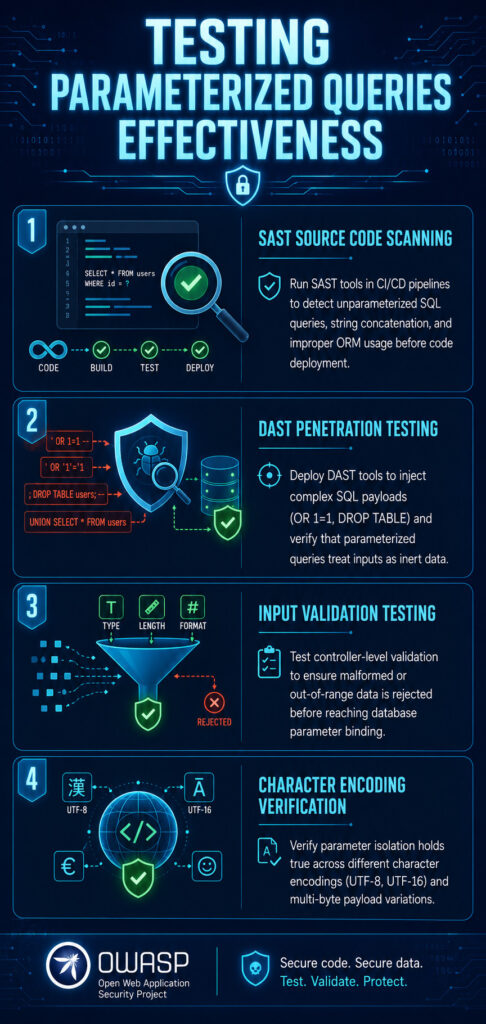
Security checks should also examine unusual character encodings and multi-byte input, which can expose problems in how applications and databases process data. By testing different inputs and query execution paths, teams can verify that parameter values remain separate from SQL instructions under a range of conditions.
What Distinguishes Validated Parameter Isolation From Dynamic Query Testing?
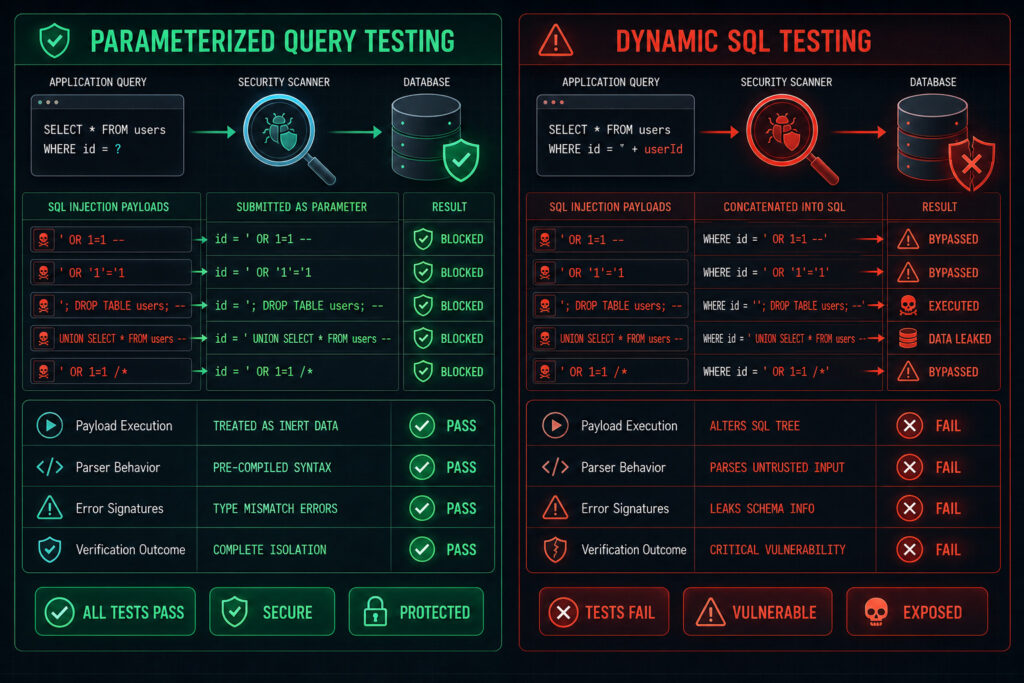
Verifying parameter handling helps confirm that backend systems treat user input as data rather than executable SQL. In contrast, testing dynamic SQL focuses on identifying cases where untrusted input can alter a query’s structure or behavior.
Security scanners and targeted tests can help uncover these weaknesses by submitting inputs designed to expose unsafe query construction. Developers should also review how queries are built, confirm that parameter binding is used correctly, and test edge cases to identify potential SQL injection vulnerabilities.
Properly configured database drivers help keep user input separate from SQL commands. Developers can apply these protections across backend systems using parameterized queries for database security.
Automated security tests can then check whether injected characters remain data rather than being treated as SQL instructions. The comparison below highlights key differences between parameterized queries and traditional dynamic SQL during security testing.
| Testing Dimension | Parameterized Query Architecture | Dynamic SQL Concatenation |
| Payload Execution | Payload characters are treated purely as inert data values | Injected syntax alters the original SQL execution tree |
| Parser Behavior | Pre-compiles statement syntax before binding parameters | Continuously parses untrusted inputs as active commands |
| Error Signatures | Triggers standard database type or length mismatch errors | Returns detailed SQL syntax errors or leaks schema information |
| Verification Outcome | Confirms complete isolation across all input channels | Identifies critical vulnerability requiring immediate remediation |
How Does Input Validation Reinforce Parameterized Security Controls?
Input validation reinforces parameterized security controls by rejecting data that doesn’t meet expected formats, types, or length limits before it reaches the database. While parameterized queries keep user input separate from SQL commands, validation adds another layer of protection by checking whether the input is acceptable for the application. Using both helps reduce security risks and improve the consistency of database operations.
Input validation checks whether submitted values meet expected rules for type, length, and format. Rejecting malformed or out-of-range data early helps prevent unexpected inputs from reaching database operations. Combined with parameterized queries, these checks add another layer of protection against SQL injection and other input-related issues.
Effective security testing should examine both application-level validation and database parameter binding. For example, testing bean validation rules before executing a query can reveal whether invalid data is rejected at the right stage.
Early validation can also reduce unnecessary database work by filtering out invalid requests before query execution. Enterprise development teams should apply consistent validation rules across application layers to keep data handling predictable and secure.
Enterprise application development guidelines emphasize standardizing data validation rules across application layers:
“Bean Validation provides a common way of validation through constraint declaration and metadata for Java applications.” – Spring Framework Bean Validation Documentation
How Do Security Scanners Test Parameter Isolation?
Security scanners test parameter isolation by sending crafted inputs to application endpoints and checking whether those inputs can alter SQL query behavior. These tests may include special characters, injected SQL logic, and unusual character encodings to identify potential injection vulnerabilities.
The results help developers determine whether queries use parameter binding correctly or expose unsafe dynamic SQL paths. However, automated scans can’t guarantee that an application is free of SQL injection, so they should be combined with code reviews and targeted security tests.
When scanners test a parameterized endpoint, they check whether input values remain separate from SQL commands. Database engines should treat characters such as quotes, semicolons, and comment markers as data rather than executable SQL. Developers can better understand this protection by examining how parameterized queries prevent SQL injection in backend applications.
Security teams can also include these tests in continuous integration pipelines to catch unsafe query construction before code reaches production. Static analysis tools can flag risky SQL patterns, while dynamic testing can reveal weaknesses in application behavior. Neither method alone guarantees complete security, so teams should combine automated checks with code reviews and targeted penetration tests.
Key testing methods include:
- Automated scanning: Sends crafted inputs to check whether SQL command structures can be altered.
- Dynamic analysis: Examines application responses for signs of unexpected query behavior.
- Continuous integration checks: Flags unsafe database calls before code is merged into production.
Can Automated Penetration Testing Detect Parameterization Flaws?
Credits: Hacksplaining
Automated security tools help development teams find query construction flaws before applications reach production. Static Application Security Testing (SAST) tools examine source code for risky patterns, such as building SQL queries through string concatenation. Dynamic Application Security Testing (DAST) tools test running applications by sending crafted inputs to identify possible SQL injection vulnerabilities.
Regular security scans can also uncover unsafe raw SQL queries hidden inside custom ORM routines or other database access layers. Finding these issues early gives developers time to fix them before deployment.
- SAST tools flag unsafe query construction and unparameterized SQL in source code.
- DAST tools send attack payloads to running applications to check whether user input can alter SQL commands.
How Does Jakarta Bean Validation Standardize Input Constraints?
Testing parameterized queries helps verify that database layers handle untrusted input safely. Applications also need consistent validation rules to reject invalid data before it reaches the database. Jakarta Bean Validation allows developers to define these rules directly on Java data models using constraint annotations.
These checks help ensure that incoming data meets expected requirements before the application runs database operations. Using shared validation rules across Jakarta EE and Java SE environments also makes application behavior more consistent. Rejecting invalid input at the API controller layer can reduce unnecessary database calls and limit malformed values reaching parameterized statements.
The official specification describes the standard’s purpose and compatibility across Java environments:
“This document is the specification of the Java API for JavaBean validation in Jakarta EE and Java SE.” – Jakarta Bean Validation 3.1 Specification
How Do Enterprise Runtimes Execute Parameter Security Verification?
Testing parameterized queries against SQL injection helps teams verify that database drivers handle user input safely across different backend environments. Whether an application uses Java, PHP, or another language, security testing should confirm that parameter binding keeps user input separate from SQL commands, even under heavy workloads.
Developers can apply these practices when using prepared statements in Java and PHP to protect database operations. Integration tests can check whether frameworks pass parameters correctly to database drivers and avoid unsafe dynamic SQL construction.
Testing across different platforms also helps teams catch configuration errors and differences in how frameworks handle database requests. Regular security checks can keep these protections consistent throughout the software development life cycle.
- Driver security testing: Checks whether database drivers handle parameters separately from SQL commands across different runtimes.
- Input handling tests: Verify that special characters in user input remain data rather than changing SQL command structure.
- Integration testing: Checks whether prepared statements behave reliably during concurrent database operations.
FAQ
Why Test Parameterized Queries for SQL Injection if Prepared Statements Are Already Used?
Security testing helps identify mistakes that can weaken prepared statements, such as unsafe SQL concatenation in custom ORM queries or legacy database calls. Automated tests check whether user input remains separate from SQL commands across application endpoints, helping developers find vulnerabilities before attackers can exploit them.
Can automated DAST scanners accurately test parameterized query effectiveness?
Yes, DAST scanners inject complex SQL control characters and payload variations into application inputs to monitor execution behavior. If the application returns standard data responses or schema validation errors instead of executing injected commands, the scanner confirms that parameter isolation is functioning effectively.
What is the difference between testing input validation and testing parameterization?
Input validation testing checks whether the application boundary correctly filters, sanitizes, or rejects malformed data formats. Parameterization testing verifies that even if a payload passes initial input validation, the database engine executes the query structure separately from the parameter data, preventing SQL execution.
How do character encoding mismatches affect parameterized query security?
Improperly configured database drivers or multibyte character encodings can occasionally lead to parser mismatches if the database driver converts string bytes improperly before binding. Security testing evaluates these edge-case payloads to ensure that parameter isolation holds true regardless of the character encoding used.
Should SAST tools be included in continuous integration pipelines for parameter security?
Yes, SAST tools scan source code during every build to flag unparameterized SQL queries, string formatting routines, or improper ORM usages before code merges into production. Integrating SAST into continuous integration pipelines ensures that non-secure database calls are caught early in development.
Securing Enterprise Applications Through Regular Security Testing
Testing parameterized queries against SQL injection helps teams check whether database drivers and ORM frameworks handle user input safely. Although parameterized queries reduce injection risks, mistakes in query construction or database configuration can still leave applications vulnerable.
Automated SAST and DAST scans help detect unsafe SQL string concatenation and other weaknesses before deployment. Regular testing also checks whether user input remains separate from SQL commands, helping protect application data and maintain reliable database operations.
To strengthen your team’s security testing skills and backend defenses, join our secure coding bootcamp.
References
- https://docs.spring.io/spring-framework/reference/core/validation/beanvalidation.html
- https://jakarta.ee/specifications/bean-validation/3.1/jakarta-validation-spec-3.1.html