


Input validation frameworks help protect enterprise applications by checking data before it reaches backend systems. They verify input types, formats, and lengths to catch invalid data and reduce the risk of injection attacks. For teams following Secure Coding Practices, these frameworks offer a consistent way to validate incoming requests and reduce security risks without adding unnecessary complexity to development workflows. Read on to learn how input validation frameworks work and how to use them to strengthen application security.
Enforcing Strict Data Boundaries Secures Backend Architectures
Integrating automated validation layers guarantees that backend applications process only verified, structurally sound data streams.
- Using Input Validation Frameworks eliminates malicious payloads by enforcing rigid type casting and length constraints at the application boundary.
- Standardized validation schemas reduce manual coding errors and maintain consistent security protocols across distributed microservice environments.
- Automated validation pipelines reject malformed API requests instantly, preventing unauthorized structural modifications to underlying database engines.
Why Are Automated Validation Layers Mandatory?
Input validation frameworks help protect backend systems by checking untrusted data before it reaches application logic. By enforcing clear rules for acceptable input, they reduce the risk of malformed or malicious data causing security issues.
Relying on manual validation alone can lead to inconsistencies and missed checks, especially as applications grow and attack techniques evolve. Automated frameworks provide a more consistent way to validate incoming API requests against predefined schemas, helping catch unexpected values early.
These libraries can handle tasks such as type checking, pattern matching, and boundary checks. Applying validation consistently across distributed services helps reduce the attack surface and catch invalid input before it causes problems. However, validation is only one layer of defense and should be combined with parameterized queries, appropriate access controls, and other secure coding practices.
How Do Frameworks Compare To Manual Validation?
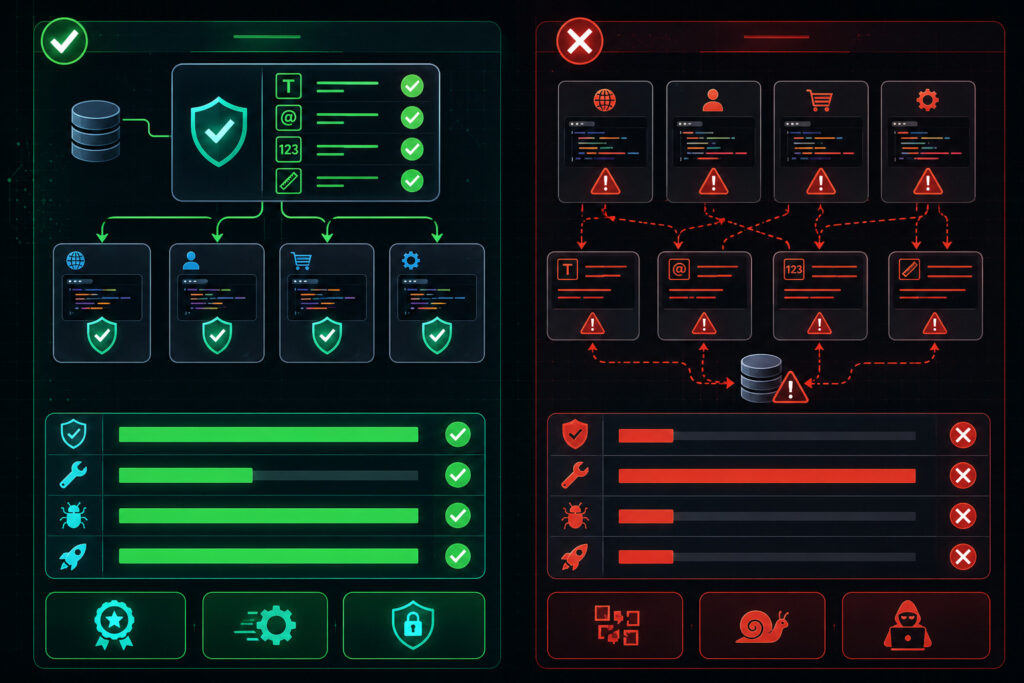
Using input validation frameworks helps teams apply consistent security checks across growing enterprise applications. Custom validation functions can also be effective when properly maintained. Understanding the difference between input validation and sanitization helps developers decide when to reject invalid data and when to clean input before processing it.
Automated validation libraries provide deterministic security based on strict allow-listing principles rather than error-prone block-listing. The table below illustrates the operational advantages of leveraging standardized framework abstractions over ad-hoc manual routines:
| Evaluation Criteria | Input Validation Frameworks | Manual Custom Validation |
| Policy Consistency | Centralized schemas enforce uniform rules globally | Disjointed logic across different application modules |
| Maintenance Overhead | Updates propagate automatically via library versions | Requires manual refactoring of individual code blocks |
| Threat Mitigation | Rejects payloads using battle-tested regex algorithms | High risk of evasion due to developer oversight |
| Implementation Speed | Accelerates deployment via pre-built rule decorators | Slows development cycles with redundant coding tasks |
How Do Validation Frameworks Complement Prepared Statements?
Input validation frameworks check incoming data before backend queries run, while parameterized queries help protect database operations from injection attacks. These techniques serve different purposes and work together to strengthen application security. The benefits of using validation framework libraries become clearer when considered alongside the capabilities of popular input validation frameworks for Java, which help developers enforce data rules across their applications.
OWASP emphasizes combining these defense layers for absolute data integrity:
“Prepared statements ensure that an attacker is not able to change the intent of a query, even if SQL commands are inserted by an attacker.” – OWASP SQL Injection Prevention Cheat Sheet
How Do Custom Validation Rules Work?
Credits: Talented Developer
Input validation frameworks let development teams define rules that go beyond basic type checks. When built-in constraints don’t cover specific business requirements, developers can create custom schemas to validate data according to their application’s needs. Customizing input validation framework rules allows teams to adapt validation to more complex requirements, while a server-side validation framework for Node.js can help enforce these rules before data reaches backend services.
- Frameworks support custom regex pattern injection to validate proprietary data formats securely before processing.
- Engineers can integrate asynchronous database checks directly into the initial API request validation pipeline.
- Customized error messaging payloads prevent sensitive backend architecture details from leaking to external API consumers.
How Do Frameworks Enhance Parameterized Defenses?
Input validation frameworks help teams check incoming data against defined rules before it reaches backend systems. Parameterized queries add another layer of protection by separating SQL commands from the values supplied to them. Developers can apply these practices using Python input validation libraries and integrate validation into web applications to keep data checks consistent across different layers of an application.
Leading security organizations consistently recommend combining strict validation pipelines with pre-compiled database execution templates. The OWASP foundation highlights the architectural simplicity and absolute security gained by defining SQL structures before passing parameters:
“Prepared statements are simple to write and easier to understand than dynamic queries, and parameterized queries force the developer to define all SQL code first and pass in each parameter to the query later.” – OWASP SQL Injection Prevention, Prepared Statements
Why Combine Client and Server Validation?
Input validation frameworks on the frontend help users catch errors before submitting a form, reducing unnecessary requests to the server. Frameworks used for client-side validation in Angular and React can check required fields, data formats, and other input rules as users interact with an application.
Client-side checks are not a substitute for server-side validation, since browser restrictions can be bypassed. Backend services must validate incoming requests independently and use parameterized queries to reduce the risk of SQL injection. Understanding the common features of input validation frameworks helps teams choose suitable validation methods for each layer.
Deploying a synchronized dual-layer validation strategy ensures optimal application performance while maintaining uncompromising zero-trust security boundaries.
- Client-side validation delivers instant user interface feedback, minimizing unnecessary network latency and backend bandwidth consumption.
- Server-side validation acts as the ultimate security gatekeeper, intercepting maliciously crafted payloads that bypass browser controls.
- Shared validation schemas between frontend and backend repositories drastically reduce code duplication and architectural synchronization errors.
How Do Teams Select Secure Frameworks?
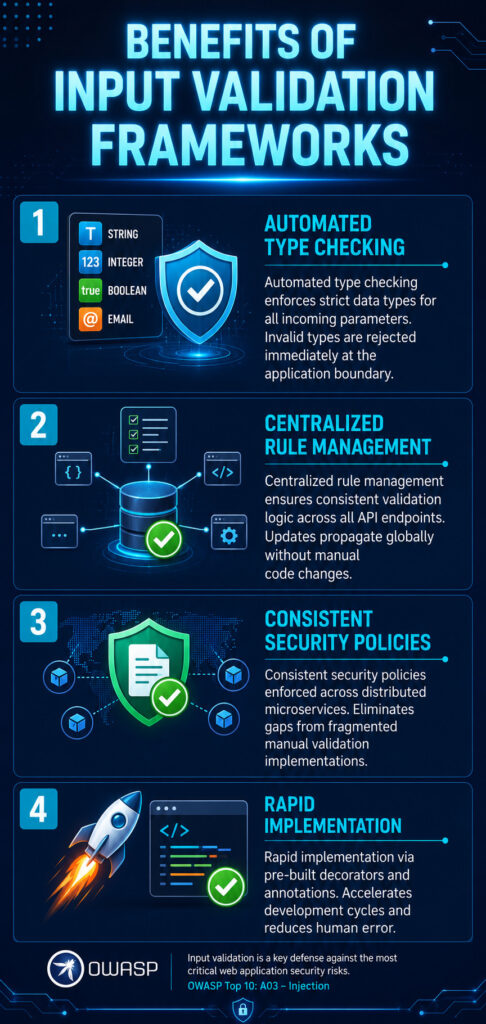
Choosing an input validation framework involves checking its maintenance history, update frequency, community support, and response to reported vulnerabilities. These factors help enterprise teams assess whether a library meets their security and compliance needs. The security considerations for choosing framework integrations also apply when extending existing libraries with custom business rules.
Developers should review custom validation logic for risks such as poorly designed regular expressions that can cause regular expression denial of service (ReDoS). Building custom validation rules securely helps address these risks when developing validation logic for enterprise applications.
FAQ
What is the primary purpose of using input validation frameworks?
Input validation frameworks establish an automated security boundary that intercepts, inspects, and verifies incoming API payloads before execution. They enforce rigid type casting, length constraints, and syntactical rules to neutralize malicious payloads instantly.
Why is client-side validation insufficient for application security?
Client-side validation optimizes user experience by providing immediate feedback, but attackers easily bypass browser restrictions using proxy tools. Backend servers must independently re-validate every incoming request to guarantee absolute structural integrity and prevent database injection.
Can custom validation rules introduce security vulnerabilities?
Yes, poorly engineered custom regular expressions or validation logic can introduce ReDoS vulnerabilities and computational bottlenecks. Developers must follow secure coding standards and utilize battle-tested library schemas when extending validation frameworks.
How do validation frameworks integrate with database parameterization?
Validation frameworks ensure that only clean, vetted primitive data types reach the backend application layer. Once validated, those inputs are passed securely to pre-compiled database statements to maintain end-to-end data safety.
What factors should architects evaluate when selecting a validation library?
Architects must evaluate community activity, vulnerability patch response history, framework performance overhead, and native integration capabilities. Ensuring active maintenance prevents long-term technical debt and protects applications against emerging exploit vectors.
Ensuring Enterprise Security Through Automated Validation
Input validation frameworks help protect web applications by checking data types, length limits, and formatting rules before input reaches backend processing logic. These checks can catch unexpected or invalid data early and reduce the risk of common security issues.
Combining input validation with parameterized queries adds another layer of protection. Validation checks whether input meets expected rules, while parameterized queries keep user-supplied values separate from SQL commands. Together with appropriate access controls and consistent security practices, these measures help protect sensitive data across distributed microservices.
Standardizing validation across applications also makes security checks easier to maintain and review. For teams looking to strengthen their secure coding practices and improve their approach to application security, the secure coding bootcamp offers an opportunity to develop these skills.
References
- https://cheatsheetseries.owasp.org/cheatsheets/SQL_Injection_Prevention_Cheat_Sheet.html
- https://cheatsheetseries.owasp.org/cheatsheets/SQL_Injection_Prevention_Cheat_Sheet.html#option-1-use-of-prepared-statements-with-parameterized-queries
Related Articles
- https://securecodingpractices.com/benefits-using-validation-framework-library/
- https://securecodingpractices.com/popular-input-validation-frameworks-java/
- https://securecodingpractices.com/input-validation-libraries-python/
- https://securecodingpractices.com/integrating-validation-framework-web-application/
- https://securecodingpractices.com/customizing-input-validation-framework-rules/
- https://securecodingpractices.com/server-side-validation-framework-node-js/
- https://securecodingpractices.com/client-side-validation-framework-angular-react/
- https://securecodingpractices.com/common-features-input-validation-frameworks/
- https://securecodingpractices.com/security-considerations-choosing-framework-integrations/
- https://securecodingpractices.com/building-custom-validation-rules-securely/