


Prepared statements help prevent SQL injection by separating SQL commands from user-supplied values. In both Java and PHP, they allow database engines to handle input as data rather than executable SQL, reducing the risk of malicious queries. This approach also supports consistent database security practices across different application environments. Keep reading to learn how prepared statements work in Java and PHP and how to implement them in your applications.
Parameterized Database Queries Block SQL Injection Vectors Completely
Separating executable SQL logic from untrusted user inputs eliminates injection vulnerabilities across application environments.
- Parameter binding guarantees that database engines treat all incoming user input strictly as literal data values.
- Pre-compiled query structures reduce execution overhead when executing repetitive database transactions across applications.
- Uniform database access layers prevent parameter manipulation across diverse backend language environments.
Why Does Parameterization Matter Across Multi-Language Backend Systems?
Secure database queries keep SQL commands separate from untrusted input. When applications concatenate user-supplied values directly into SQL strings, malicious input can alter the intended query and create opportunities for SQL injection.
Prepared statements help prevent this by separating query structure from parameter values. In both Java and PHP, developers can use parameter binding to ensure that user input is handled as data rather than executable SQL. Applying this approach consistently across different backend languages helps teams maintain stronger database security without relying on manual input escaping.
Beyond eliminating critical injection risks, prepared statement implementations deliver substantial performance benefits for high-throughput applications. Database engines compile and optimize the SQL execution plan once upon initial creation, allowing subsequent database requests to execute efficiently with different parameter values.
This pre-compilation minimizes database CPU overhead, reduces query execution cycles, and streamlines database connections across enterprise software architectures. Ultimately, standardizing database access patterns protects critical enterprise data while maintaining optimal database throughput across modern software deployments.
What Comparative Advantages Do Parameterized Engines Offer Over Dynamic Queries?
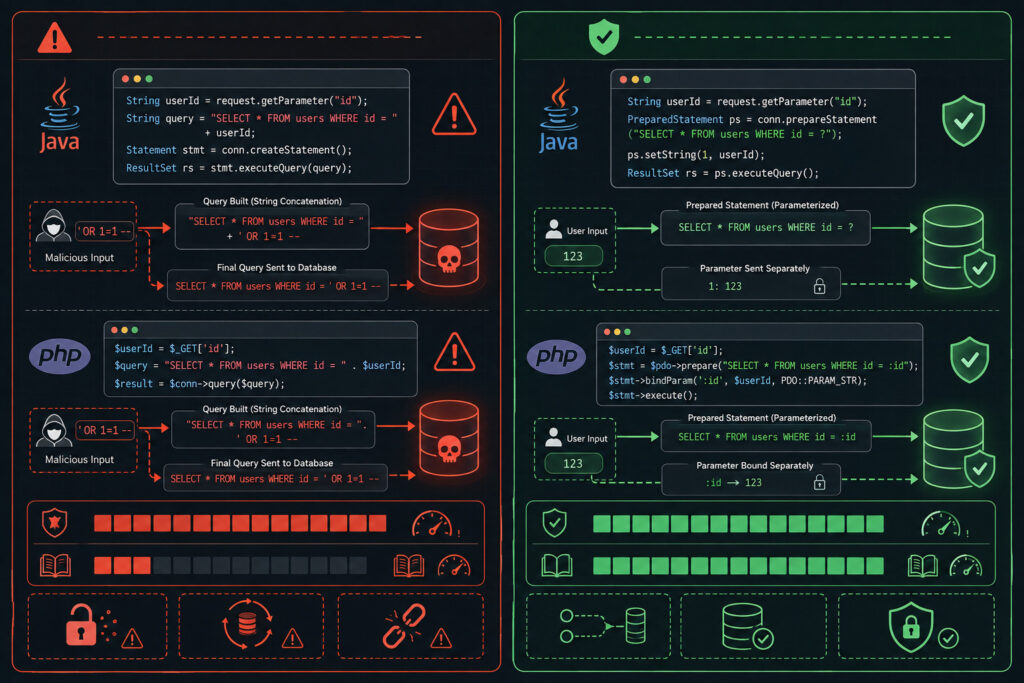
Parameterized queries reduce the risk of SQL injection by separating SQL commands from user-supplied values. Unlike dynamically constructed queries that concatenate raw input into SQL strings, parameterized statements keep input values separate from the query structure. This approach also makes database code easier to maintain across different backend environments. The security benefits become clearer when examining parameterized queries for database security and how they handle untrusted input.
| Feature / Criteria | Dynamic String Concatenation | Prepared Statements (Java JDBC / PHP PDO) |
| SQL Injection Risk | High; unescaped inputs execute directly as SQL code | Zero; driver separates executable commands from parameters |
| Query Compilation | Re-compiled by database engine on every request | Compiled once; re-used efficiently with new parameter values |
| Input Sanitization | Requires complex manual escaping per data type | Handled automatically by database driver parameter binding |
| Code Readability | Low; cluttered with quote escapes and string operators | High; clean positional (?) or named (:param) placeholders |
Why Do Official Language Specifications Mandate Parameter Binding?
Securing web applications requires developer adherence to language-level data handling standards. When implementing Using Prepared Statements Java Php workflows, database abstraction layers such as PHP Data Objects (PDO) enforce a clear separation between query structure and variable parameters.
Binding variables explicitly prevents arbitrary command execution and ensures predictable database processing.
Official language documentation underscores this imperative security design pattern:
“Use these parameters to bind any user-input, do not include the user-input directly in the query.” – PHP Manual PDO,prepare Documentation
How Do Parameterized Engines Stop SQL Injection Attempts Instantly?
Enforcing parameter placeholders converts user-supplied payload strings into inert values before database engines execute commands. When applications parse raw query strings directly, hostile attackers can append malicious SQL syntax to manipulate query logic.
Parameterized queries help prevent SQL injection by keeping user-supplied values separate from SQL commands. The separation allows database drivers to handle input as data rather than executable SQL. This process is explained in how parameterized queries prevent SQL injection across application backends. Applying prepared statements consistently in Java and PHP also helps development teams follow the same secure input-handling practices across different environments.
Database abstraction libraries transmit the query template and parameter data through completely distinct network protocols. The database server compiles the command structure first, creating an immutable execution tree before mapping variable values into defined placeholders.
Consequently, even if an attacker submits complex SQL keywords or syntax operators, the database engine treats those inputs strictly as literal string values rather than executable code. Implementing parameter binding across enterprise software projects guarantees robust data isolation while maintaining uniform data access standards.
- Database engines compile SQL query logic before binding user values to positional placeholders.
- Parameter separation prevents input data from altering command execution logic during runtime processing.
- Standardized database abstractions remove the need for fragile manual string escaping algorithms.
What Security Advantages Do Stored Procedures Provide Over Dynamic SQL?
Credits: Codecourse
Restricting direct table access through parameterized stored procedures creates an essential security perimeter around sensitive database architectures. Integrating stored execution plans alongside Using Prepared Statements Java Php access patterns ensures that backend applications enforce least-privilege security models across enterprise microservices.
Official Microsoft database documentation details how stored procedures isolate underlying data structures from unauthorized direct manipulation:
“Multiple users and client programs can perform operations on underlying database objects through a procedure, even if the users and programs don’t have direct permissions on those underlying objects.” – Microsoft Stored Procedures Database Engine Documentation
Can Prepared Statements Reduce Database Server Load?
Prepared statements can reduce database overhead when applications repeatedly execute the same query with different parameter values. Depending on the database engine and driver, reusing a prepared statement or execution plan can reduce the work required to parse and optimize each request.
In Java and PHP, developers can use prepared statements to keep SQL commands separate from user-supplied data. This helps prevent SQL injection and may improve performance under heavy workloads. The actual gains depend on the database system, driver implementation, and query patterns.
- Compiling query templates once eliminates repetitive SQL parsing overhead on database servers.
- Reusing execution plans accelerates response times across high-concurrency API environments.
Why Is Dual-Engine Parameterization Vital for Multi-Platform Applications?
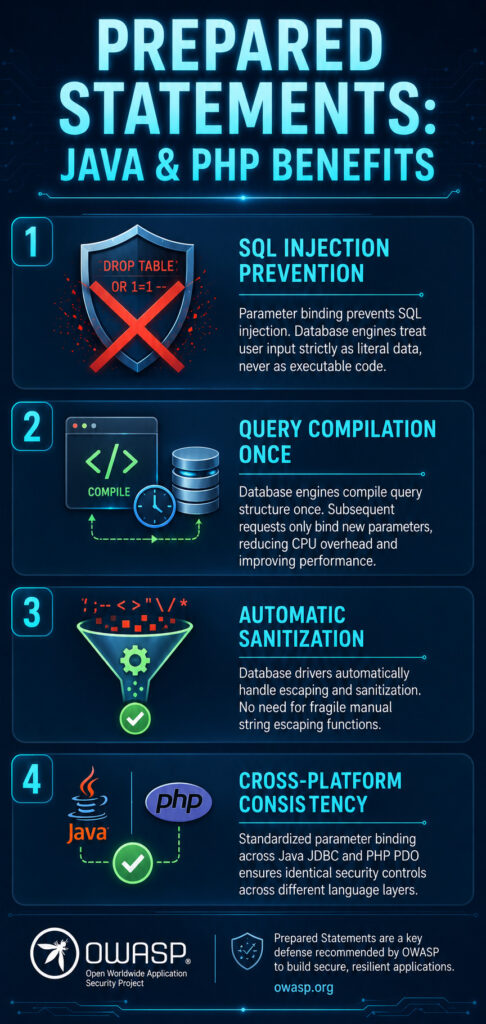
Maintaining consistent database security across different technology stacks can be challenging for engineering teams. When Java microservices and PHP web applications share database infrastructure, using different approaches to query construction can introduce avoidable security risks.
Prepared statements help standardize how both environments handle user input by separating SQL commands from parameter values. This approach reduces the risk of SQL injection and can support more efficient query execution, depending on the database and driver. These advantages are explored in the security and performance benefits of parameterized queries across enterprise applications.
Relying on language-specific string sanitization functions often leads to subtle escaping errors, character encoding mismatches, and unexpected bypasses. Parameterized statement engines bypass string manipulation entirely by transmitting SQL structural templates and input parameters via separate binary stream channels.
Database engines evaluate command boundaries prior to mapping bound values, eliminating the risk of payload injection even when handling complex UTF-8 characters or raw binary payloads. Establishing strict parameterization policies across all backend development teams ensures long-term database integrity while streamlining cross-platform code reviews.
- Abstracting database interactions through JDBC PreparedStatement and PHP PDO interfaces ensures identical security controls across different language layers.
- Eliminating dynamic string concatenation prevents payload modification vectors regardless of input encoding variations.
- Centralizing parameter binding mechanisms reduces code complexity and simplifies enterprise security compliance audits.
FAQ
What is using prepared statements java php and why is it essential for database security?
Using prepared statements java php is a database query practice that separates SQL code from user data using parameter binding, completely preventing SQL injection vulnerabilities across both Java and PHP backend applications.
How do prepared statements differ between Java JDBC and PHP PDO?
Java JDBC uses PreparedStatement with positional ? placeholders, while PHP PDO supports both positional ? and named parameters like :param, though both frameworks achieve identical underlying query compilation and parameter isolation.
Do prepared statements improve database performance?
Yes, database engines compile and optimize the SQL execution plan once upon creation, allowing subsequent queries to run faster by simply binding new parameter values into memory without re-parsing syntax.
Is string escaping a safe alternative to prepared statements?
No, manual string escaping relies on complex functions that can be bypassed by character encoding tricks or unexpected input formats, making prepared statements the only truly safe parameterization method.
Can prepared statements protect against second-order SQL injection?
Yes, because bound parameters are stored in the database purely as literal values, preventing malicious strings from executing as SQL commands even if fetched and re-processed later in application workflows.
Secure Enterprise Databases With Parameterized Excellence
Using prepared statements consistently in Java and PHP helps protect web applications against SQL injection. When applications concatenate user input directly into SQL commands, attackers may be able to manipulate queries, access sensitive data, or perform unauthorized database operations.
Prepared statements separate SQL commands from user-supplied values, reducing the risk of malicious input altering query logic. Combined with appropriate database permissions and other security controls, they help teams apply consistent protection across different application layers. Depending on the database and driver, reusing prepared statements can also improve query execution efficiency.
To strengthen your team’s database security skills, join our secure coding bootcamp to learn practical techniques for protecting enterprise applications.
References
- https://www.php.net/manual/en/pdo.prepare.php
- https://learn.microsoft.com/en-us/sql/relational-databases/stored-procedures/stored-procedures-database-engine?view=sql-server-ver17