Skip to content
No results
  • Home
  • About Us
  • Blog
  • Bootcamp
  • Contact Us
Secure Coding Practices
  • Home
  • About Us
  • Blog
  • Bootcamp
  • Contact Us
Secure Coding Practices
  • Risks of Sensitive Data Exposure

How Sensitive Data Gets Exposed by Ignoring Simple Mistakes

Isometric illustration of how sensitive data gets exposed when attackers extract records from a compromised database

How sensitive data gets exposed often comes down to simple mistakes rather than sophisticated attacks. Data is rarely stolen through dramatic breaches alone. Instead, it leaks through overlooked gaps such as misconfigured cloud storage, exposed API keys, weak access controls,…


  • Leon I. Hicks
  • June 16, 2026
  • Risks of Sensitive Data Exposure

Risks of Sensitive Data Exposure: The Hidden Threat Undermining Application Trust 

Flat vector art showing application data breach risks of sensitive data exposure.

Building secure applications requires more than functionality and performance, it demands consistent secure coding practices at every stage of development. Yet many organizations underestimate the risks of sensitive data exposure, assuming that breaches only result from sophisticated cyberattacks.  In reality,…

  • Leon I. Hicks
  • June 15, 2026
  • Analyzing Broken Authentication Flaws

Default Credentials Security Risk in Modern Systems 

Cracked shield exposing a server with a default password panel highlighting the default credentials security risk to infrastructure 

Default credentials are a preconfigured open door. They are the usernames and passwords, like admin/admin, that vendors ship with devices. If left unchanged, they give attackers immediate, authorized-looking access.  At Secure Coding Practices, we’ve seen a forgotten IP camera with…

  • Leon I. Hicks
  • June 14, 2026
  • Analyzing Broken Authentication Flaws

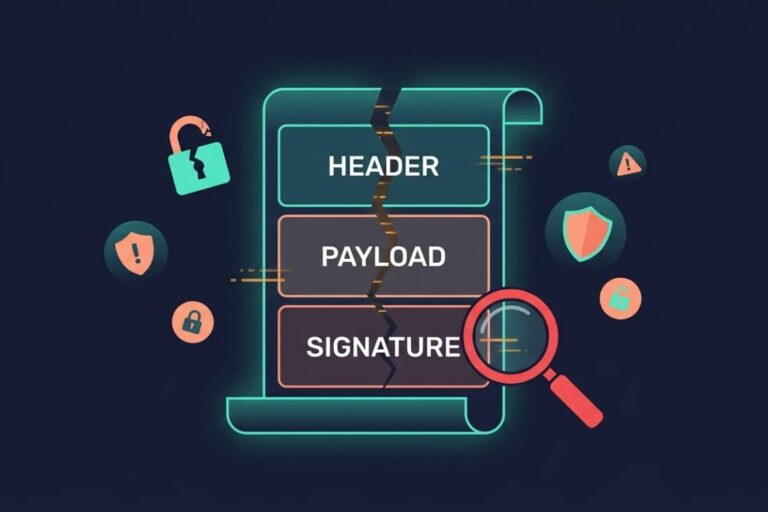
JWT Authentication Vulnerabilities Common in Apps

Cracked JWT scroll showing header, payload, and signature under a magnifying glass revealing JWT authentication vulnerabilities common 

JWT vulnerabilities often come from flawed implementation, not a broken format. At Secure Coding Practices, we’ve seen systems fail by trusting a decoded payload without verifying its signature.  The main risks are mistakes in signature verification, algorithm handling, secret management,…

  • Leon I. Hicks
  • June 13, 2026
  • Analyzing Broken Authentication Flaws

Brute Force Attack Mitigation Strategy for Security 

Glowing shield blocking waves of stolen credentials from reaching a server, visualizing a brute force attack mitigation strategy 

The best brute force defense isn’t one tool. It’s a layered strategy that makes password guessing too slow, expensive, and useless. You must slow the attack, disrupt the automation, and ensure a guessed password is never enough. At Secure Coding…

  • Leon I. Hicks
  • June 12, 2026
  • Analyzing Broken Authentication Flaws

A Practical Secure Password Reset Implementation Guide 

Desktop screen with shield and masked password field illustrating a secure password reset implementation guide for developers 

A secure password reset flow is an alternate authentication path. It must be built with the same defense as your main login. Attackers target it because it’s often the weak spot, a backdoor to account takeover. At Secure Coding Practices,…

  • Leon I. Hicks
  • June 11, 2026
  • Analyzing Broken Authentication Flaws

Better Credential Stuffing Attack Prevention Methods 

Layered digital shield blocking waves of malicious data representing credential stuffing attack prevention methods in action 

The best way to stop credential stuffing attacks is a layered strategy. It blocks reused passwords, spots automated bots, and slows down attackers without bothering real users. You must stop the automation, make stolen passwords worthless, and check if they’re…

  • Leon I. Hicks
  • June 10, 2026
  • Analyzing Broken Authentication Flaws

Multi Factor Authentication Bypass Methods and How to Stop Them

Smartphone with secure login shield blocking attacks, representing defenses against multi factor authentication bypass methods.

Your MFA isn’t as secure as you think. See the real-world techniques attackers use to get around it and the practical steps you can take to lock them out for good. Your multi factor authentication was broken because attackers used…

  • Leon I. Hicks
  • June 9, 2026
  • Analyzing Broken Authentication Flaws

Preventing Session Hijacking Techniques: A Practical Guide for Developers

Laptop with active defense shield blocking attacks, illustrating preventing session hijacking techniques via secure cookies

Learn preventing session hijacking techniques that protect web applications from modern session theft. Go beyond basic cookie flags and implement defenses that work against real-world attacks. Stop session hijacking by securing the token’s entire lifecycle: its creation, storage, transmission, validation,…

  • Leon I. Hicks
  • June 8, 2026
  • Common Vulnerabilities & Attacks, Analyzing Broken Authentication Flaws

Session Fixation Attack Explained Steps: Protect Your Accounts 

A woman logging in unaware her session ID is exposed, illustrating session fixation attack explained steps in a real-world scenario.

A session fixation attack occurs when an attacker sets a session ID before a user logs in and tricks them into using it, allowing the attacker to hijack the session after authentication. Unlike traditional session hijacking, which targets active sessions,…

  • Leon I. Hicks
  • June 8, 2026
Prev
1 … 14 15 16 17 18 19 20 … 60
Next
Secure Coding Practices

Join a thriving global community of developers dedicated to writing cleaner, safer, and more resilient code. Whether you're just starting out or leveling up your skills, this bootcamp gives you the practical knowledge and hands-on experience needed to identify vulnerabilities, apply secure coding principles, and build software that stands up to real-world threats.

Join the Next Bootcamp →

  • About us
  • Blog
  • Bootcamp
  • Disclaimer
  • Contact us
  • Privacy Policy
  • Terms & Conditions

Copyright © 2026 SecureCodingPractices.com — All rights reserved.