Skip to content
No results
  • Home
  • About Us
  • Blog
  • Bootcamp
  • Contact Us
Secure Coding Practices
  • Home
  • About Us
  • Blog
  • Bootcamp
  • Contact Us
Secure Coding Practices
  • XML External Entity (XXE) Prevention, Common Vulnerabilities & Attacks

XXE Attack: What Happens When It Succeeds 

Impact of successful XXE attack exposing sensitive files, internal servers, and cloud metadata

A successful XML External Entity attack can expose sensitive files, trigger internal network requests, and weaken system security. Guidance from OWASP shows how XML parsing flaws can turn a small configuration mistake into a wider security issue. In practice, XXE…

  • Leon I. Hicks
  • July 4, 2026
  • XML External Entity (XXE) Prevention, Common Vulnerabilities & Attacks

Using Safer XML Processing Libraries: Security Basics 

Using safer XML processing libraries to filter and validate XML data before secure parsing and storage

Safer XML processing libraries reduce exposure to XML External Entity (XXE) attacks and parser-based risks. We see this in enterprise data pipelines, where misconfigured parsers open quiet entry points, and legacy systems still running make it worse. Secure Coding Practices shape…

  • Leon I. Hicks
  • July 3, 2026
  • XML External Entity (XXE) Prevention

Disabling External Entities XML Parsers for XXE 

XML document passing through a security shield that blocks malicious payloads by disabling external entities xml parser before reaching the server.

Disabling external entities XML parser is the only guaranteed defense against XXE attacks. Major security standards all agree. But many modern applications still parse untrusted XML with unsafe, default settings. This lets attackers steal server files, probe internal networks, or…

  • Leon I. Hicks
  • July 2, 2026
  • XML External Entity (XXE) Prevention

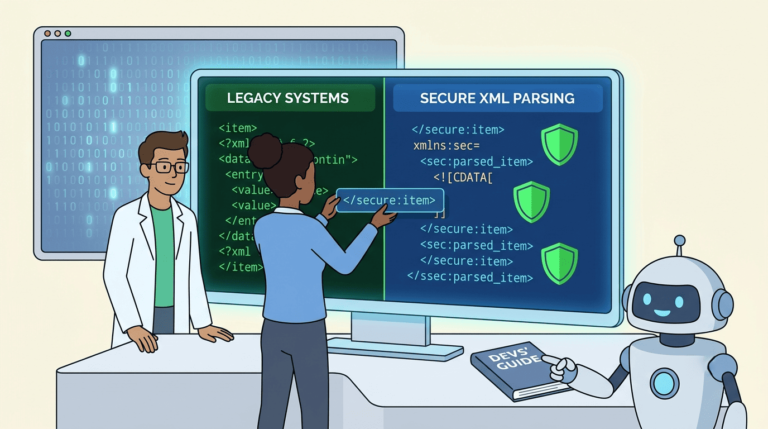
XXE Mitigation Strategies Developers Guide: Secure XML Parsing Without Breaking Legacy Systems

Developers comparing legacy and secure XML parsing on a screen, referencing an xxe mitigation strategies developers guide with a robot assistant.

Disable external entity resolution in your parser to stop XXE attacks. The real problem is making that change without breaking old SOAP services your company still needs. This guide tackles that exact issue, showing you how to tighten security while…

  • Leon I. Hicks
  • July 1, 2026
  • XML External Entity (XXE) Prevention

Testing for XXE Vulnerabilities Tools That Work 

Security analyst reviewing XML config on a monitor while testing for xxe vulnerabilities tools with a holographic dashboard.

Testing for XXE vulnerabilities tools requires a precise approach, not just sending basic XML. You’re hunting for a parser misconfiguration, a hidden door left unlocked. The right method listens for the faint callback from a server that shouldn’t respond.  This…

  • Leon I. Hicks
  • June 30, 2026
  • XML External Entity (XXE) Prevention

XXE Attack Examples, Scenarios, & Code Explained 

XML data record being sent to a secured server, representing xxe attack examples scenarios code in a cloud environment.

An XXE attack examples, scenarios, & code: it exploits a badly set up XML parser. Attackers use it to pull internal files, call out to networks, or crash services. The problem isn’t XML, it’s the configuration of the software reading…

  • Leon I. Hicks
  • June 29, 2026
  • XML External Entity (XXE) Prevention

Preventing XXE Injection Java .NET: Complete Guide for Secure XML Parsing

Secured software architecture graphic focusing on preventing xxe injection java .net with a digital shield.

Preventing XXE injection Java .NET means killing DTD processing. It’s mandatory, not optional. The instant a parser loads an external DTD, you’re compromised. This flaw persists, even in trusted libraries. Your ideas about safe defaults are likely mistaken. Let’s get…

  • Leon I. Hicks
  • June 28, 2026
  • XML External Entity (XXE) Prevention

What Is XXE Vulnerability Attack? A Silent XML Exploit You Can Stop

Diagram showing what is xxe vulnerability attack through silent data injection exploit targeting a compromised server node.

What is XXE vulnerability attack? It’s a hack where an attacker manipulates an XML parser to read files from the server or interact with internal systems. This happens when an app blindly trusts XML input. It’s a serious flaw often…

  • Leon I. Hicks
  • June 27, 2026
  • Common Vulnerabilities & Attacks

XML External Entity (XXE) Prevention: Stop Attacks by Locking Down Your Parser

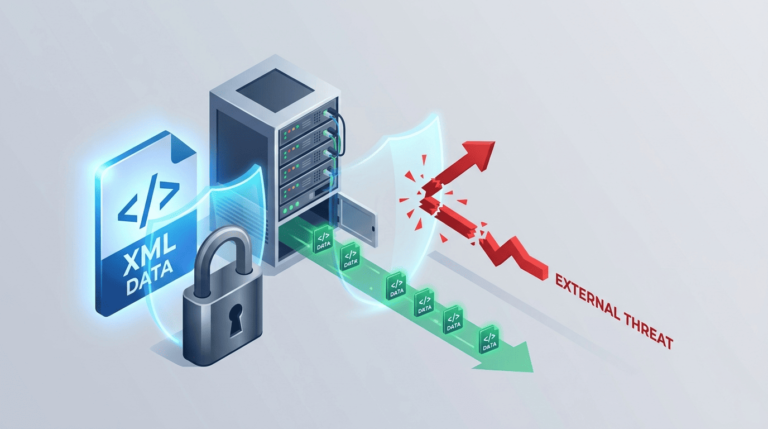
XML External Entity (XXE) Prevention shield blocking external threats from accessing XML data on a server.

XML External Entity (XXE) Prevention is the process of securing XML parsers against attacks caused by unsafe handling of DTDs and external entities. If a parser is configured incorrectly, attackers may access sensitive files like /etc/passwd or probe internal systems.…

  • Leon I. Hicks
  • June 26, 2026
  • Risks of Sensitive Data Exposure

TLS Configuration Mistakes Data Exposure in 2026 

TLS Configuration Mistakes Data Exposure audit team reviewing outdated protocols and certificate alerts in security center 

TLS configuration mistakes data exposure remains a serious problem because encryption alone does not guarantee security. Many organizations still experience data leaks caused by weak settings, failed certificate checks, outdated protocols, and unnoticed downgrade paths. The issue is often not…

  • Leon I. Hicks
  • June 25, 2026
Prev
1 … 12 13 14 15 16 17 18 … 60
Next
Secure Coding Practices

Join a thriving global community of developers dedicated to writing cleaner, safer, and more resilient code. Whether you're just starting out or leveling up your skills, this bootcamp gives you the practical knowledge and hands-on experience needed to identify vulnerabilities, apply secure coding principles, and build software that stands up to real-world threats.

Join the Next Bootcamp →

  • About us
  • Blog
  • Bootcamp
  • Disclaimer
  • Contact us
  • Privacy Policy
  • Terms & Conditions

Copyright © 2026 SecureCodingPractices.com — All rights reserved.